What is bio-charcoal (biochar)?
A story that did not begin with agriculture at all
If you ask someone to name the greatest discoveries of the 16th century, they will most likely recall Columbus, Magellan or the conquistadors who conquered the Inca Empire. But few people know that one of humanity's most important findings turned out to be neither gold, nor silver, nor new lands. It lay literally underfoot — in ordinary black soil.
Today this soil is called Terra Preta — "black earth". It was this soil that, almost five centuries later, helped scientists understand how the ancient inhabitants of Amazonia managed to create incredibly fertile land in a place where nature seemingly left no chance for farming at all.
The story of biochar begins neither in a laboratory, nor at an agricultural station, nor even on a farm. It begins with one of the most mysterious expeditions of the Age of Discovery.
Chapter one. The search for El Dorado
In the middle of the 16th century Europe was gripped by a genuine gold rush.
After the conquest of the Inca Empire, tons of precious metals poured into Spain. Every new expedition hoped to find yet another wealthy state hidden somewhere beyond the mountains, forests or endless plains of South America.
Travelers searched with particular persistence for the legendary El Dorado.
At first it was believed to be a man — a ruler who covered his body with gold dust during religious ceremonies.
Later the legend turned into a tale of an entire city.
Then — of a whole state.
In time El Dorado became a symbol of the endless treasures supposedly hidden deep within the continent.
In 1541 the Spanish conquistador Gonzalo Pizarro, brother of the famous Francisco Pizarro, set out on one of the largest expeditions of his time.
Several hundred Spaniards.
Several thousand native porters.
Horses.
Pigs.
Cannons.
Enormous stores of provisions.
Everyone was certain that within a few months they would return with untold riches.
But instead of gold the expedition was met by hunger, disease, swamps and impassable jungle.
A river without end
After a few months the situation became desperate.
The men ate leather straps, boiled their saddles and slaughtered the last of the horses.
To find food, Pizarro sent ahead a small detachment under the command of Captain Francisco de Orellana.
The plan was simple.
Sail down the great river.
Find provisions.
Come back.
But the river proved too powerful.
The current was so strong that going back upstream turned out to be impossible.
Orellana faced a terrible choice.
Try to return — and almost certainly perish.
Or continue downstream, hoping that the river would one day lead to the ocean.
He chose the second.
That is how, entirely by chance, the first journey in human history along the whole length of the Amazon began.
The witness no one believed
The expedition included the Dominican friar Gaspar de Carvajal.
It is to him that we owe one of the most astonishing documents of the 16th century.
Carvajal recorded in detail everything he saw.
And this is where the real mystery begins.
Contrary to European expectations, the travelers were not moving through uninhabited jungle at all.
Quite the opposite.
Along almost the entire length of the huge river they encountered settlements.
One after another.
Sometimes small ones.
Sometimes enormous ones.
Carvajal wrote that some stretches of the banks were so densely populated that it seemed as if the boats were passing one continuous city.
He described wide roads, large houses, numerous fields, fortified settlements, thousands of inhabitants and lively trade between the tribes.
To 16th-century Europe such accounts sounded incredible.
Most scholars decided that the traveler had simply exaggerated what he had seen.
For how could so developed a civilization exist in the middle of the jungle?
Why Carvajal turned out to be right
Almost four hundred years passed.
Researchers came to Amazonia again and again.
But they found no enormous cities.
Only small villages lost in the endless forest.
Gradually a theory arose that was considered indisputable for almost the whole of the 20th century.
Amazonia is an immense virgin forest.
The soils here are extremely poor.
They are incapable of feeding a large population.
Consequently, no developed civilizations ever existed here.
It followed that Carvajal had either been mistaken or had deliberately embellished his account.
That was the view for decades.
Until archaeologists began to look literally beneath the ground.
The jungle knows how to hide its secrets
The Amazon forest has an astonishing ability.
It erases the traces of human activity very quickly.
An abandoned house disappears within a few decades.
Wooden structures rot away.
Roofs cave in.
Lianas entwine the walls.
A hundred years later a real forest is already growing where the village stood.
After two hundred years it becomes almost impossible to guess that people once lived here.
That is precisely why for a long time archaeologists found practically nothing.
But at the end of the 20th century satellite imagery appeared, and after it the technology of lidar, which makes it possible to "see through" the forest canopy with a laser.
And it turned out that beneath the dense greenery lie the remains of roads, embankments, canals, plazas and entire urban complexes.
Today no one doubts any longer:
before the arrival of the Europeans Amazonia was populated far more densely than was previously believed.
But along with this a new question arose.
If Carvajal really did see enormous settlements…
If developed agriculture existed here…
If the population numbered in the millions…
Then what did they feed all these people with?
Because the soils of Amazonia, strange as it may seem, are almost unsuitable for agriculture.
This is where the next chapter of our story begins — the story of the most unusual soil on the planet.
Chapter two. The strangest soil on Earth
There is an astonishing paradox here.
Looking at a satellite photograph of Amazonia, it seems to be one of the most fortunate places on the planet. An endless green ocean of trees, thousands of plant species, an incredible diversity of animals. One gets the impression that nature itself created ideal conditions for life here.
In reality it is almost the other way round.
Most Amazonian soils are extremely poor.
To a European agronomist they would look almost hopeless.
How can that be?
The answer lies in the climate itself.
The rain that steals fertility
In central Russia rain is considered the farmer's ally.
It brings moisture.
It dissolves mineral substances.
It helps plants.
In Amazonia rain behaves quite differently.
In many areas the annual precipitation amounts to two, three and sometimes even four thousand millimetres. By comparison, in most Russian regions this figure is several times lower.
Imagine someone pouring dozens of buckets of water through a huge flowerpot every day.
What will happen?
First the water will wash out the soluble substances.
Then the nutrients.
Then practically nothing but a mineral skeleton will remain.
This is exactly what has been happening to Amazonian soils for thousands of years.
Every new rainy season literally flushes the ground right through.
Calcium.
Potassium.
Magnesium.
Nitrogen.
Phosphorus.
Everything gradually moves down into the depths or is washed away into the rivers.
That is why fertility here does not live in the soil at all.
It lives… in the forest itself.
A forest that feeds on itself
This is one of the most beautiful ecological systems on Earth.
Practically all the nutrients are held not in the ground but in the plants.
A fallen leaf lands on the surface.
A few weeks later it has almost ceased to exist.
Fungi.
Bacteria.
Insects.
Termites.
Earthworms.
Thousands of organisms instantly break the organic matter down into its components.
The roots of the trees immediately intercept the released nutrients.
The result is an astonishing cycle.
The nutrients barely have time to reach the soil.
They are constantly "in motion" between the plants and the microorganisms.
That is why, if you simply clear a patch of forest and start growing crops, the yield is usually good only for the first two or three years.
Then the land becomes sharply poorer.
This is precisely why many ancient peoples practiced slash-and-burn agriculture, constantly moving on to new plots.
But the inhabitants of Amazonia, it seems, found another solution.
The soil that should not exist
Archaeologists noticed the first unusual patches as early as the 19th century.
Sometimes, amid the familiar reddish-yellow soil, small islands of almost black earth appeared.
They differed sharply from the surrounding ground.
They were loose.
Dark.
Rich in organic matter.
And the most astonishing thing —
plants grew magnificently on them.
Local people had long known these places and readily used them for growing crops.
But for a long time scientists did not understand the origin of this soil.
Some considered it volcanic.
Others suggested the influence of ancient lakes.
Still others saw nothing special in it at all.
Only in the second half of the 20th century did it become clear:
this soil was created by human beings.
Terra preta — a technology older than Rome
Today the term Terra Preta de Índio is translated as "the black earth of the Indians".
But this is by no means a natural soil type.
It is the result of many years of human work.
And of incredibly painstaking work at that.
Picture an ordinary village.
Every day its inhabitants cook food.
They tend their hearths.
They clean fish.
They slaughter animals.
They mend pottery.
They clear away plant residues.
Most of this waste gradually ended up in designated places.
But along with the food remains, one more material regularly found its way there.
Charcoal.
Not ash.
Precisely pieces of incompletely burnt charcoal.
Over decades, and sometimes centuries, they were mixed with compost, bones, ash, manure, crushed pottery, plant residues and microorganisms.
In this way an entirely new soil gradually came into being.
People were literally creating it with their own hands.
A mistake that turned out to be a stroke of genius
The most interesting thing is that the ancient inhabitants of Amazonia most likely did not understand the chemistry of the processes involved at all.
They did not know the word "carbon".
They could not measure acidity.
They had no idea what cation exchange capacity was.
They simply noticed a pattern.
Wherever a lot of charcoal ended up in the ground, plants grew better.
Yields held up longer.
The soil became depleted more slowly.
Sometimes humanity's greatest discoveries begin exactly like this.
With a practical observation.
Without formulas.
Without laboratories.
Without universities.
Why did this soil not disappear after a thousand years?
This is where the real scientific marvel begins.
Every gardener knows:
humus gradually disappears.
Compost decomposes.
Manure is processed by microorganisms.
Even a thick layer of organic matter turns within a few years into carbon dioxide, water and mineral substances.
But charcoal behaves in a completely different way.
During pyrolysis wood undergoes a profound transformation.
The volatile compounds leave.
The tars are destroyed.
What remains is almost pure carbon, organised into an extremely stable structure.
For soil microorganisms such a material turns out to be almost inedible.
While an ordinary leaf becomes food within a few months, high-quality biochar is able to persist in the soil for hundreds and even thousands of years.
That is precisely why modern archaeologists still find patches of terra preta created long before the arrival of the Europeans.
They are still working.
Still holding water.
Still accumulating nutrients.
Still remaining considerably more fertile than the surrounding soils.
One might say that the ancient inhabitants of Amazonia once made a long-term deposit in the "fertility bank", on which nature is still paying interest today.
When history met modern science
For a long time terra preta remained a curious archaeological puzzle.
But at the end of the 20th century soil scientists decided to study it not as a historical artifact but as a model.
They asked a simple question:
if this technology worked two thousand years ago, can it work today?
The answer turned out to be unexpected.
Not only can it.
In many cases it works so well that it is capable of changing the very approach to farming.
First, however, it was necessary to understand what exactly makes charcoal such an unusual material.
Why is one small black fragment able to hold water, fertiliser and life far more effectively than ordinary soil?
To answer this question, scientists had to look literally inside each granule of biochar. And what they saw under the electron microscope turned out to be even more astonishing than the story of terra preta itself.
Chapter three. What a piece of black charcoal conceals
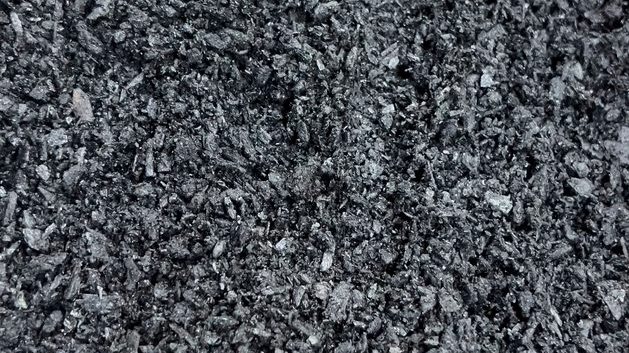
Take a granule of high-quality biochar in your hand.
It looks completely ordinary.
Light.
Black.
Rough.
It resembles a small piece of charcoal left after a campfire.
This is exactly where most people make their first mistake.
They think they know what they are holding.
In reality, appearances are deceptive.
Magnify the surface of biochar even a thousand times and the familiar piece of charcoal disappears.
A completely different world opens up before us.
A forest inside the tree
Wood was never solid.
Inside every trunk there is an extremely complex system of microscopic channels.
Water once moved through them.
Dissolved minerals rose up through them.
Sugars formed by the leaves circulated through them.
This is the plant's real transport network.
When wood turns into ordinary ash, this whole architecture disappears.
When it burns slowly in a campfire, most of the structure is also destroyed.
But when pyrolysis is carried out correctly, something astonishing happens.
The organic substances gradually leave the wood.
Yet the spatial structure itself is preserved almost completely.
The result is a kind of "cast" of the tree.
Only now it consists mainly of carbon.
One might say that biochar is the petrified architecture of a living tree.
A journey inside
Modern electron microscopes make it possible to magnify the surface of biochar tens of thousands of times.
In these images the familiar charcoal is impossible to recognize.
A fantastic landscape appears before the researcher.
Tunnels.
Caves.
Arches.
Shafts.
Bridges.
Labyrinths.
Sometimes the images resemble a coral reef.
Sometimes — a frozen volcanic landscape.
Sometimes — a futuristic city.
It is this structure that determines almost all the properties of biochar.
An enormous area in a tiny volume
Picture an ordinary sugar cube.
From the outside its surface is quite small.
But if there were millions of microscopic cavities inside it, each with its own walls, the total area would grow hundreds of times over.
With biochar this is exactly what happens.
One kilogram of high-quality biochar can have an internal surface comparable to the area of several football fields.
These figures are so unusual that at first they seem to be a mistake.
But the point is not the size of the granule.
The point is the number of internal surfaces.
Every pore has walls of its own.
Every wall interacts with water.
Every one becomes a place where microorganisms live.
That is why a small volume of material is able to influence the soil so strongly.
In scientific publications the internal surface area of biochar is usually measured in square metres per gram of material. For high-quality biochar it can amount to hundreds of square metres per gram — the value depends on the feedstock and the pyrolysis regime.
Why a sponge is not the best analogy
Biochar is very often called a sponge.
This is a useful comparison.
But not an entirely accurate one.
An ordinary sponge consists of large pores.
Biochar is arranged in a far more complex way.
It has a whole hierarchy of internal spaces.
Scientists divide them into three main groups.
Macropores
These are the largest channels.
They were once the tree's vascular system.
Water passes through them easily.
Air penetrates them.
The roots of young plants grow into them.
One might say that these are the streets of a big city.
Mesopores
They are considerably smaller.
This is where water is retained.
This is where nutrients dissolve.
This is where the first colonies of microorganisms begin to live.
These are no longer streets.
Rather courtyards and small side lanes.
Micropores
It is these that make biochar unique.
Their dimensions are measured in millionths of a metre.
Some are so small that water is held inside them by capillary forces.
Even when the surrounding soil begins to dry out, part of the moisture remains inside these microscopic reservoirs.
The result is a kind of emergency reserve.
During a drought plants continue to receive water for considerably longer.
Why the water does not run away
Every gardener knows this simple picture.
Heavy rain has fallen.
The next day the ground is already almost dry.
Where has the water gone?
Part of it evaporated.
Part of it went deeper.
Part of it ran off over the surface.
In light sandy soils this process happens especially quickly.
Biochar changes the very geometry of the soil.
It does not create water.
It creates places where water can be retained.
Picture two identical warehouses.
One completely empty.
The other filled with thousands of shelving racks.
The amount of air is the same.
But the capacity is completely different.
The pores of biochar work in much the same way.
They create an enormous number of internal "shelves" on which water molecules are held.
Invisible magnets
But water is far from the most interesting part.
If biochar retained only moisture, it would be no more than a good soil conditioner.
Its real value lies elsewhere.
The surface of biochar has electrical properties.
Active sites gradually appear on it that are able to hold positively charged ions.
Calcium.
Potassium.
Magnesium.
Ammonium.
It is precisely these elements that are especially important for plants.
Ordinary sandy soil loses them easily after heavy rain.
Biochar begins to work like an enormous network of miniature magnets.
It does not lock the nutrients away forever.
It holds them long enough for the roots to make use of the reserve.
That is why scientists often speak not about the amount of fertiliser but about the efficiency of its use.
Sometimes what matters is not adding more nutrients.
What matters is to stop losing them.
An apartment block underground
The most astonishing feature of biochar, however, has nothing to do with water or minerals.
It has to do with life.
Billions of microorganisms can live in a single gram of healthy soil.
Bacteria.
Fungi.
Actinomycetes.
Protozoa.
Each of them does its own work.
Some decompose organic matter.
Others make phosphorus available.
Others help plants obtain nitrogen.
Still others protect the roots from disease.
But all of them need a home.
Biochar becomes exactly such a home.
Its pores protect the microbes from drying out.
From sharp changes in temperature.
From the small predators that live in the soil.
One might say that every granule gradually turns into a real residential district for the soil microflora.
And the longer biochar stays in the ground, the more actively this invisible ecosystem develops.
Why biochar gets better with age
Most materials gradually age.
Concrete cracks.
Metal rusts.
Plastic breaks down.
With biochar almost the opposite process takes place.
After it is applied to the soil, its surface gradually becomes covered with the thinnest films of organic substances.
The pores are colonized by microorganisms.
Mineral elements accumulate.
Stable microbial communities form.
That is why many studies show that the maximum effect of high-quality biochar does not always appear in the first season.
Sometimes it becomes more noticeable after two, three or even five years.
This is a rare example of a material that does not lose its properties but gradually reveals them.
A material the 21st century turned out to need
When scientists finally understood how biochar is built, it became clear that what they had before them was not merely an interesting archaeological object.
It is a universal natural platform.
A material that is able at one and the same time to hold water, retain nutrients, support the life of soil microorganisms and lock up carbon for a long time.
And then a question arose that no longer concerned agriculture alone.
If a single ancient material is able to solve so many problems at once, might it not help humanity to answer the challenges of the 21st century — soil depletion, climate change and the growing need for sustainable farming?
It was precisely this question that became the starting point of a new wave of research, thanks to which the word "biochar" has over the past twenty years turned from a narrow scientific term into one of the most widely discussed topics in modern agroecology.
Chapter four. When an ancient technology met the 21st century
In the early 2000s the word biochar was known to only a few soil scientists.
Today it can be found in scientific journals, at international climate conferences, and in research from universities and agricultural institutes all over the world.
Why has the interest arisen precisely now?
The reason is simple.
Humanity has come up against several problems at once that were long considered entirely unrelated.
Soils are gradually losing their fertility.
Droughts are becoming longer.
Fertilisers are getting more expensive.
Organic matter in agricultural land is decreasing.
And the concentration of carbon dioxide in the atmosphere continues to rise.
And unexpectedly it turned out that a single material is able, at least in part, to help solve every one of these problems.
Carbon that does not return to the atmosphere
As a tree grows, it does an astonishing job.
Using the energy of the sun, it extracts carbon dioxide from the air.
From it the wood, bark, leaves and branches are built.
In essence, a tree is a natural carbon accumulator.
But after that one of two scenarios usually follows.
If the tree rots, the carbon gradually returns to the atmosphere.
If it is burned, this process happens almost instantly.
During pyrolysis a third path appears.
A significant part of the carbon passes into an extremely stable form.
Once it enters the soil, such carbon can persist for centuries.
That is why scientists increasingly call biochar a form of long-term storage of atmospheric carbon.
The result is an unusual chain.
The tree takes CO₂ out of the air.
Biochar holds this carbon in the ground.
And at the same time the soil becomes more fertile.
It is rare to find a technology that benefits agriculture and the environment at once.
There is no magic powder
On the internet you can sometimes come across claims that biochar can instantly increase yields several times over.
Such promises should be treated with caution.
Science says something quite different.
Biochar is not a fertiliser.
It contains almost no available nitrogen.
It does not replace phosphorus.
It is not able on its own to provide plants with everything they need.
Its role is a completely different one.
It helps the soil make more efficient use of what is already there.
This is a very important distinction.
The soil can be compared to a large warehouse.
Fertilisers are the goods.
And biochar is a modern storage system.
The warehouse itself produces nothing.
But it makes it possible to lose considerably less.
That is why the effect of biochar shows itself particularly well in combination with organic fertilisers, compost and sound agricultural practice.
Why people speak of the "nitrogen dip"
This is one of the best-known questions that novice users have.
Sometimes, after fresh biochar is applied, plants develop more slowly than expected in the first season.
Does that mean the technology does not work?
In fact a perfectly natural process is taking place.
Think of a new kitchen sponge.
If you drip a little water onto it, almost all the moisture is instantly absorbed inside.
Until the sponge is saturated, it will go on soaking up water.
Fresh biochar behaves very similarly.
Its numerous pores at first begin to fill with water, dissolved mineral substances and nitrogen compounds.
This is a temporary phenomenon.
After some time a microbial ecosystem of its own forms inside, and the material begins gradually to return the accumulated substances to the plants.
That is why specialists recommend that, before use, you charge the biochar.
What it means to "charge" biochar
The name sounds almost like a term from electronics.
In reality everything is much simpler.
Charging biochar means filling its pores in advance with everything that should work for the benefit of plants.
This is done using:
- mature compost
- well-rotted manure
- organic fertilisers
- compost tea
- vermicompost infusions
- solutions of compound fertilisers
- microbial inoculants.
After such preparation, biochar enters the soil no longer empty.
Its internal "apartments" are already populated with beneficial microflora.
Its "reservoirs" are filled with water and nutrients.
As a result, the effect becomes noticeable considerably faster.
This is exactly why many modern products are already pre-activated biochar.
Where biochar is used today
When you hear the word "biochar", it is easy to picture a small garden plot.
But modern practice moved far beyond the vegetable garden long ago.
Today biochar is used:
- in industrial greenhouse complexes
- in intensive fruit orchards
- in vineyards
- in berry crop production
- in ornamental plant nurseries
- in the restoration of depleted farmland
- in reforestation
- in the reclamation of disturbed land
- in urban landscaping
- in the production of specialty soil substrates.
In each of these areas the objectives differ slightly.
But the principle remains the same.
To make soil more resilient.
More alive.
More efficient.
Why OMEGA produces classic biochar in particular
Studying international experience, it is easy to notice an interesting pattern.
Despite the enormous number of new developments, practically all of them start from one and the same foundation.
From high-quality classic biochar.
That is precisely why the company OMEGA focuses first and foremost on producing a stable, high-quality material.
The basis is carefully prepared wood feedstock.
The pyrolysis regime is selected so as to preserve a well-developed porous structure and to obtain a material with predictable properties.
The biochar is then graded into fractions, which is especially important for different applications — from houseplants to field crops.
This approach makes it possible to use it both on its own and as a basis for more complex products.
It is on this basis that modern formulations are created, including pre-activated ("charged") versions.
A history two thousand years long
There is a particular beauty in the fact that some of humanity's great discoveries do not lose their value millennia later.
Long ago the inhabitants of the Amazon simply noticed that charcoal helps the land stay fertile.
They did not know chemistry.
They did not use microscopes.
They could not explain what was happening with formulas.
But they learned to observe nature.
Today scientists are able to describe the processes taking place inside every granule of biochar.
We know how its pores work.
How soil microflora develops.
How water and nutrients are retained.
How carbon remains in the soil for centuries.
But the idea itself has remained the same.
Not to fight nature.
But to help it do what it does best.
Perhaps that is precisely why the story of biochar feels so contemporary.
It is not so much a story about charcoal.
It is a story about how knowledge accumulated by many generations of people can survive the centuries and become sought after again at the moment when humanity is looking for paths to a more sustainable future.
What is worth remembering
- Biochar is not a fertiliser but a long-term soil improver.
- Its history goes back more than two thousand years.
- The basis of its effectiveness is a well-developed porous structure and a stable carbon framework.
- The maximum effect is achieved when it is used together with organic fertilisers or after preliminary "charging".
- It is one of the few materials that simultaneously helps plants, the soil and the long-term retention of carbon.
If classic biochar is this good — how did the world learn to make it even smarter? That is the subject of the second article in the trilogy.