OMEGA's developments: biochar as it is becoming in Russia
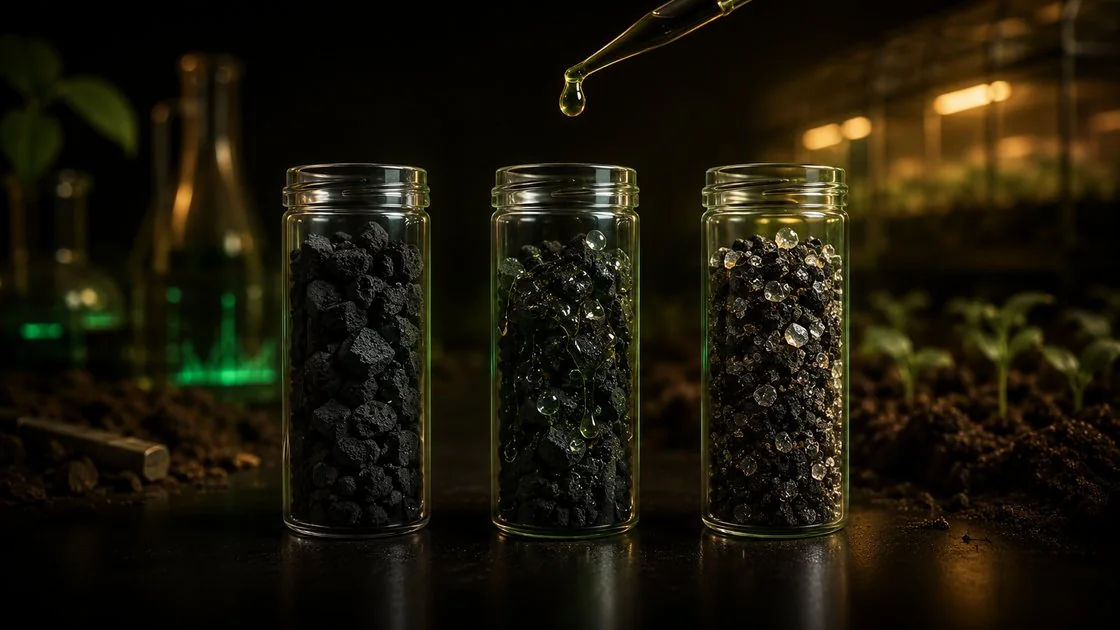
In three articles we have covered almost everything.
What biochar is and where it came from.
Why it works.
What happens to it in the soil — today, after a season and after decades.
One question remains.
What can an ordinary Russian company do with all this knowledge — here and now, on its own production line?
This article is the answer.
We will describe it in detail: classic biochar, "charged" versions, live bacterial additives and series with potassium and phosphorus that are new to Russia.
But with one honest caveat.
We will tell you what we do and why.
And we will not reveal exactly how — the precise formulations, dosages and process parameters remain our know-how.
This is what all serious developers do. And you will soon understand why it is the right thing to do.
Chapter one. It all starts with honest classic biochar
In the earlier articles we noted an important pattern.
However "smart" modern biochar may be, it almost always starts from one and the same base.
From high-quality classic biochar.
That is why we started with it too.
Our biochar is made from birch.
It undergoes pyrolysis in a regime that preserves a well-developed pore structure — the very "petrified architecture of wood" discussed in the first article.
High carbon content.
Low ash content.
Predictable properties that are reproduced from batch to batch.
Why sizing matters more than it seems
If you look through online reviews of biochar, one and the same complaint comes up again and again.
"Dust. A fine fraction. It blows away in the wind when you apply it."
This is not a trifle.
Biochar that is too fine and unscreened is inconvenient to apply, it generates dust and is lost.
We solve this at the production stage.
The charcoal is crushed and screened into fractions — we have screening capacity of up to a tonne of charcoal per hour, into several fractions at once.
The coarse fraction is for heavy soils and gardens, where air-filled voids matter.
The medium fraction is the universal one.
The fine fraction is for seedlings and indoor plants, where rapid contact with the soil is needed.
One material — but for different tasks.
About a third of the entire biochar market is simply pure charcoal with no enrichment at all. This is precisely why the quality and sizing of the base determine almost everything: any "smart" version built on a poor base will not work.
Chapter two. "Charging" biochar: from compost to "Turbo"
We remember the key idea from the second article.
Fresh biochar cannot simply be poured into the ground in the hope of a miracle.
First it goes through a "saturation period" — greedily taking up water and nutrients, like a new sponge.
This means it needs to be "charged" in advance.
And this is where things get really interesting.
Most producers on the market charge biochar in a primitive way.
They simply mix the charcoal mechanically with an additive — a fertiliser, a humate or vermicompost.
The nutrients then stay on the outside, on the surface of the particles.
We took a different route.
Not sprinkling on top, but impregnating all the way through
Imagine two ways of preparing a sponge for cleaning.
You can sprinkle detergent powder on top of it.
Or you can soak it through with a solution, so that every pore is filled.
The difference is enormous.
In the first case almost everything will be washed off by the very first water.
In the second, the sponge will release the agent gradually, as it works.
It is the same with biochar.
We do not mix the nutrients with the charcoal superficially.
We saturate the pores themselves — what science calls impregnation.
The nutrients go inside the porous matrix.
And then they come out slowly and on demand from the roots.
This kind of genuine pore saturation is almost non-existent on the mass market.
Biochar with compost and organic matter
The most intuitive form of "charging" is organic.
We combine biochar with mature compost and organic extracts.
Life colonises the pores, and nutrients settle on the pore walls.
Biochar like this arrives in the soil no longer empty.
Its "apartments" are occupied and its "reservoirs" are full.
It does not take nutrients away from the bed in the first season — it starts giving them back straight away.
"Omega-Turbo" — our flagship
"Turbo" is biochar whose pores are saturated with a balanced complex of nitrogen, phosphorus and potassium together with a full set of chelated micronutrients — iron, manganese, zinc, copper, boron, molybdenum.
Why chelated in particular?
A chelate is a micronutrient in a "protective shell" that keeps it available to the plant and prevents it from turning into an unavailable form.
And why do we make a point of not over-drying the product?
Because strong heating would destroy these delicate compounds.
Our process is gentle, with no forced high-temperature drying.
The micronutrients are preserved.
The product is ready to use almost immediately.
And the nutrients leave the pores not all at once, but gradually — in a prolonged release.
"Turbo" is suitable for vegetable, fruit and berry, flower and ornamental crops — and at the same time it improves the structure of the soil itself.
Compound fertilisers with a full set of chelated micronutrients, and genuinely absorbed into the pores of the biochar at that, are a great rarity on the mass market. Most "enriched" products are simple mechanical mixtures.
Chapter three. A living additive: biochar with bacteria
In the third article we talked in detail about biochar being an ideal home for microorganisms.
Porous. Protected. With stable moisture inside.
It would seem enough to settle beneficial bacteria in it and you have a live biological preparation.
But there is a trap here.
Why living and "charged" do not go well together
Live microbes are not a powder that can sit on a shelf forever.
They need water in order to wake up, but in a moist, salt-rich environment they quickly die or use themselves up ahead of time.
This is exactly why many "live" biochars on the market have a short shelf life.
And it is exactly why another frequent customer complaint appears — a "stuck-together, caked surface" in products with liquid inoculation.
We solved this problem in a fundamentally different way.
The microbes are kept separate and dry
Our live range is built differently.
The beneficial microorganisms are not mixed into the moist mass of the biochar.
They are stored separately, in dry form, and are combined with the biochar and the soil at the moment of application.
While the product sits in the warehouse, the microbes are dormant and remain viable.
They "wake up" only when they reach moist soil — where they belong.
As a result they arrive at the vegetable bed alive rather than dying on the way.
Who these helpers are
We work with two proven allies of the grower.
Hay bacillus (Bacillus subtilis) — a bacterium that suppresses pathogenic fungi in the root zone and helps to make the soil healthier.
Trichoderma (Trichoderma) — a soil fungus, a natural protector of roots and an active participant in the decomposition of organic matter.
To these we add an organic "charge" — humic and fulvic acids, which serve both as nutrition and as a starter medium for the microflora.
The result is not just charcoal and not just a fertiliser.
The result is a starter kit for living soil.
Dry forms of beneficial microorganisms keep considerably longer than liquid ones. And current research shows that the composition of the soil microbiota can influence yields no less than the amount of fertiliser applied.
Chapter four. New to Russia: the potassium and phosphorus series
So far we have talked about "charging" with nitrogen, organic matter and microbes.
But a plant has different needs at different times.
In spring, during vigorous growth of green mass, nitrogen matters most of all.
In the second half of the season and in autumn, other elements come to the fore.
Potassium and phosphorus.
These are the elements responsible for flowering, for the filling and ripening of the fruit, for root development and for preparing the plant for winter.
This is how our two targeted seasonal series came about.
The "Summer series" — potassium and phosphorus for the second half of summer
Picture a fruiting plant in July.
The green mass has already been built up.
Now all the attention goes to the flowers, the fruit set and the fruit.
It is at this moment that the plant particularly needs potassium and phosphorus.
The "Summer series" is based on monopotassium phosphate, a rare case where potassium and phosphorus are combined in a single substance, with no unnecessary ballast.
Biochar like this works not on the foliage but on the harvest — on its taste, filling and ripening.
The "Autumn series" — phosphorus for preparing the soil for winter
Autumn is the time to think not about the foliage but about the roots and the coming season.
Phosphorus strengthens the root system.
It helps the plant to go into winter calmly.
And it lays the foundation for next year's harvest.
That is why the "Autumn series" is phosphorus-based and is designed for autumn soil preparation.
It is made by a "dry" method, without soaking — which is convenient precisely for autumn application under digging.
Why this is "new to Russia"
We have studied the market closely.
Biochar with targeted seasonal potassium-phosphorus formulations of this kind is practically absent from the mass market.
There is pure biochar. There are simple mixtures. There are a few humates and some liquid Trichoderma.
But a well-thought-out seasonal range built "for the task" is almost nowhere to be found.
This is the gap we are filling.
Geography helps as well.
Major Russian producers of phosphorus and potassium raw materials operate nearby, in our own region.
That means stable supplies and a sensible price — without long logistics chains.
Potassium is often called the "quality element": it governs the plant's water regime, the taste of the fruit and frost resistance. Phosphorus, meanwhile, is the "element of energy and roots". This is why it makes sense to apply phosphorus in autumn, and potassium together with phosphorus in the run-up to fruiting.
Chapter five. Why we do not disclose our recipes — and why that is right
Reading this article, you may have noticed one particular feature.
We have described in detail what we do and why.
But nowhere have we given precise formulations, dosages or process parameters.
This is not an accident.
Behind each of our products lies scientific and technical work — with trials, protocols and calculations.
The fine details of that work are the main value.
That is why we follow a simple principle.
We protect the architecture of our technologies with patents and applications.
And we keep the fine parameters as know-how — a trade secret of production.
A competitor may see the idea.
But will not be able to reproduce the recipe.
These are not just words.
OMEGA already holds a granted patent and registered computer programs, including our own "EcoTech" system.
A patent application has been filed for the key method of enriching biochar.
This is how developments turn from "an idea in words" into a protected asset of the company.
Why this matters to you
Behind all the technology there is a simple benefit for the buyer.
You get biochar that does not take nutrients away from the soil in the first season, but starts giving them back straight away.
You can choose a product to match the task and the season.
Need growth and all-round nutrition — "Turbo".
Need living, healthy soil — the version with bacteria.
Second half of summer, fruit filling — the "Summer series".
Autumn preparation for winter — the "Autumn series".
And in every case the base is honest, size-graded birch biochar with no dust.
That very "black earth" effect, which works not for one season but for years.
What is worth remembering
- The basis of everything is high-quality birch biochar, graded into fractions, with no dust or fines.
- We saturate the pores themselves with nutrients (we impregnate them) rather than simply mixing the charcoal with an additive.
- "Omega-Turbo" — an NPK complex with chelated micronutrients and a gentle process without over-drying; the nutrients are released gradually.
- The live range — the microorganisms (hay bacillus and Trichoderma) are stored dry and separately, so that they reach the vegetable bed alive.
- The "Summer" (potassium + phosphorus) and "Autumn" (phosphorus) series — targeted seasonal ranges that are new to the Russian market.
- The formulations and parameters are our know-how; the principles and the benefits are open.
A story that has come full circle
Remember how the first article began.
Two thousand years ago the inhabitants of Amazonia noticed that charcoal makes the land fertile.
They knew neither chemistry nor microbiology.
They simply observed nature — and worked together with it.
Today we have electron microscopes, laboratories and precise knowledge of what happens inside every pore.
But the idea itself has remained the same.
Not to fight nature, but to help it do what it does best.
And perhaps this is exactly why the story of biochar continues.
It began in the ancient settlements of Amazonia.
And today it continues here — with birch biochar from Krasnokamsk.