Roller press or extruder: why the shape and the heat differ so much
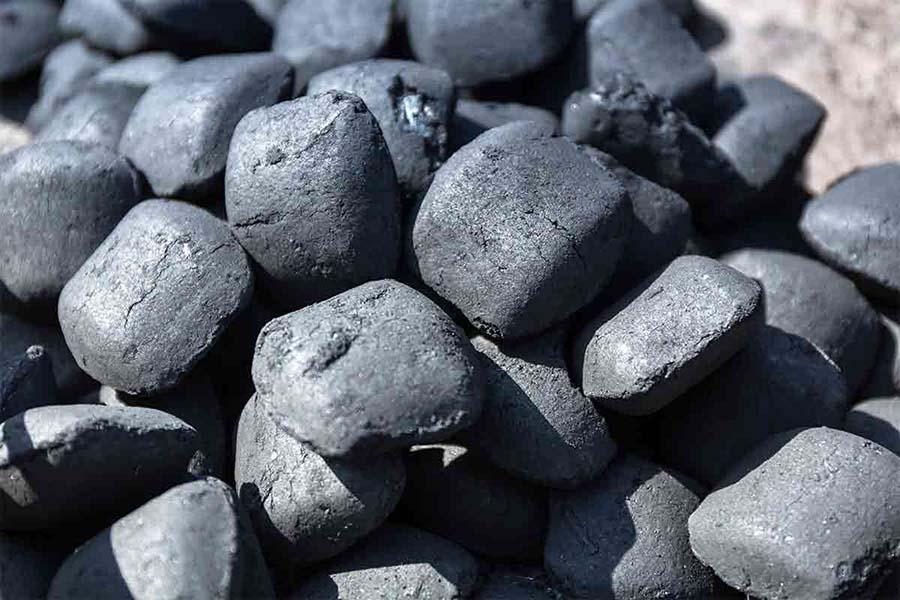
Today there are two main technologies for making charcoal briquettes worldwide: roller pressing and extrusion. It is the technology that determines how long the charcoal burns, how much heat it gives off, how badly it crumbles in transit and how much dust ends up at the bottom of the bag. Let us look in plain language at how these methods differ and why producers of professional charcoal increasingly choose the extruder.
Why the production technology matters more than the shape
When a buyer sees two equally black briquettes, it seems that only their appearance differs. In practice it is not so. When cooking meat, fish or vegetables, what matters is not the neat edges of the product but three things:
- how much heat the briquette can store;
- how evenly it releases that heat;
- how long it holds its working temperature.
All of these properties are created back at the plant — at the moment when charcoal powder turns into a dense monolith. That is precisely why two briquettes of the same weight can behave completely differently on the grill.
The roller press — fast production of a mass-market product
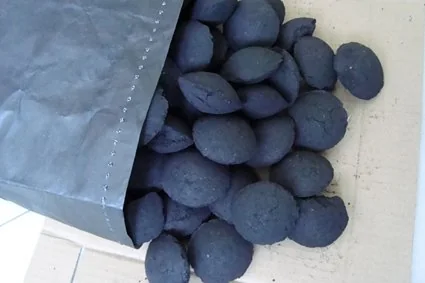
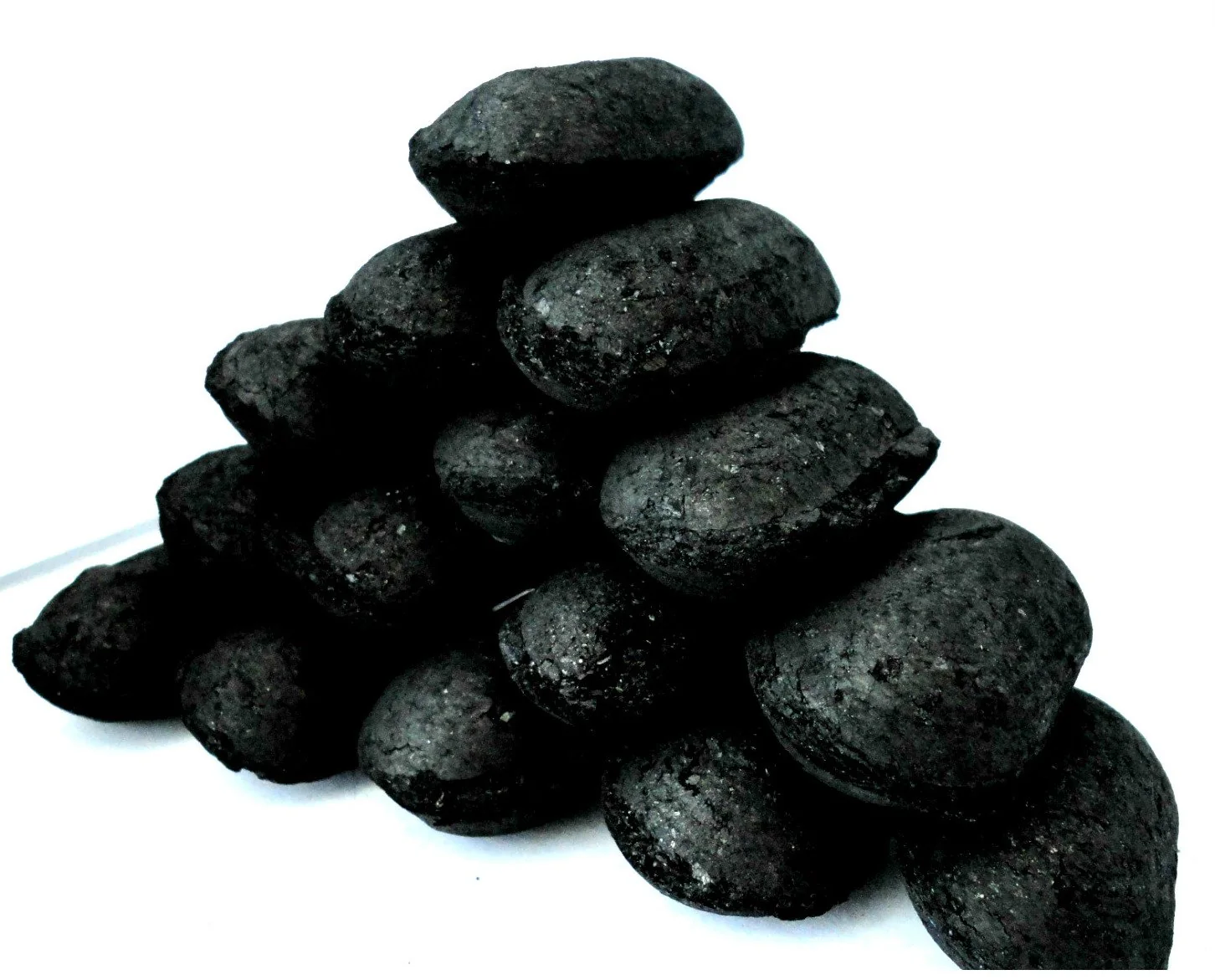
The most widespread technology in mass production is the roller press. Its principle is fairly simple. Two massive rotating rollers carry special recesses ("pockets"). A charcoal blend with a binder is fed between them. As they rotate, the rollers literally "snap" the material into shape and squeeze out the characteristic oval "pillows". These are the briquettes most often found on supermarket shelves.
The advantages of the technology are obvious:
- very high output;
- relatively inexpensive equipment;
- low production cost;
- the ability to turn out dozens of tonnes per shift.
That is why roller pressing has become the standard of the mass market. But high speed comes at a price.
Why roller-pressed briquettes are less dense
In a roller press the material stays under pressure for a very short time — usually a fraction of a second. In that time the blend simply cannot compact as much as it does under extrusion. So the manufacturer has to increase the amount of binder — it is the binder that holds the shape of the finished "pillow".
The consequences are lower density, higher porosity, more microcracks and lower mechanical strength. It is briquettes like these that most often begin to crumble in transit. Many people will have noticed that a visible layer of charcoal dust and small fragments sometimes collects at the bottom of the bag — one of the typical results of a less dense structure.
What this means for the buyer
The buyer does not care at all how the charcoal was made. What matters is something else: that the bag arrives intact, that the charcoal does not fall apart in your hands, that the heat is steady and that you do not have to keep adding new briquettes. This is exactly where the production technology becomes decisive.
The extruder — an entirely different approach
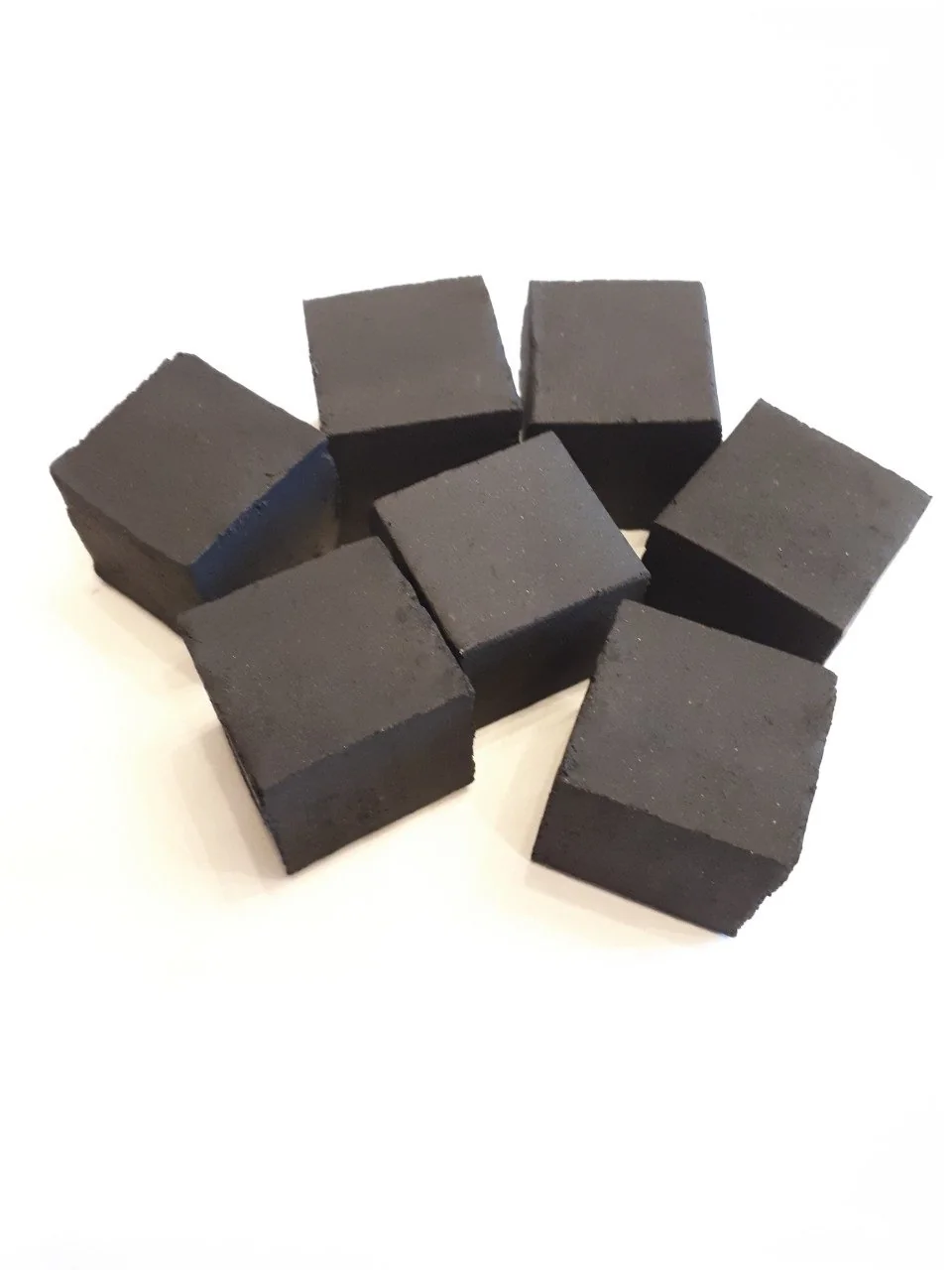
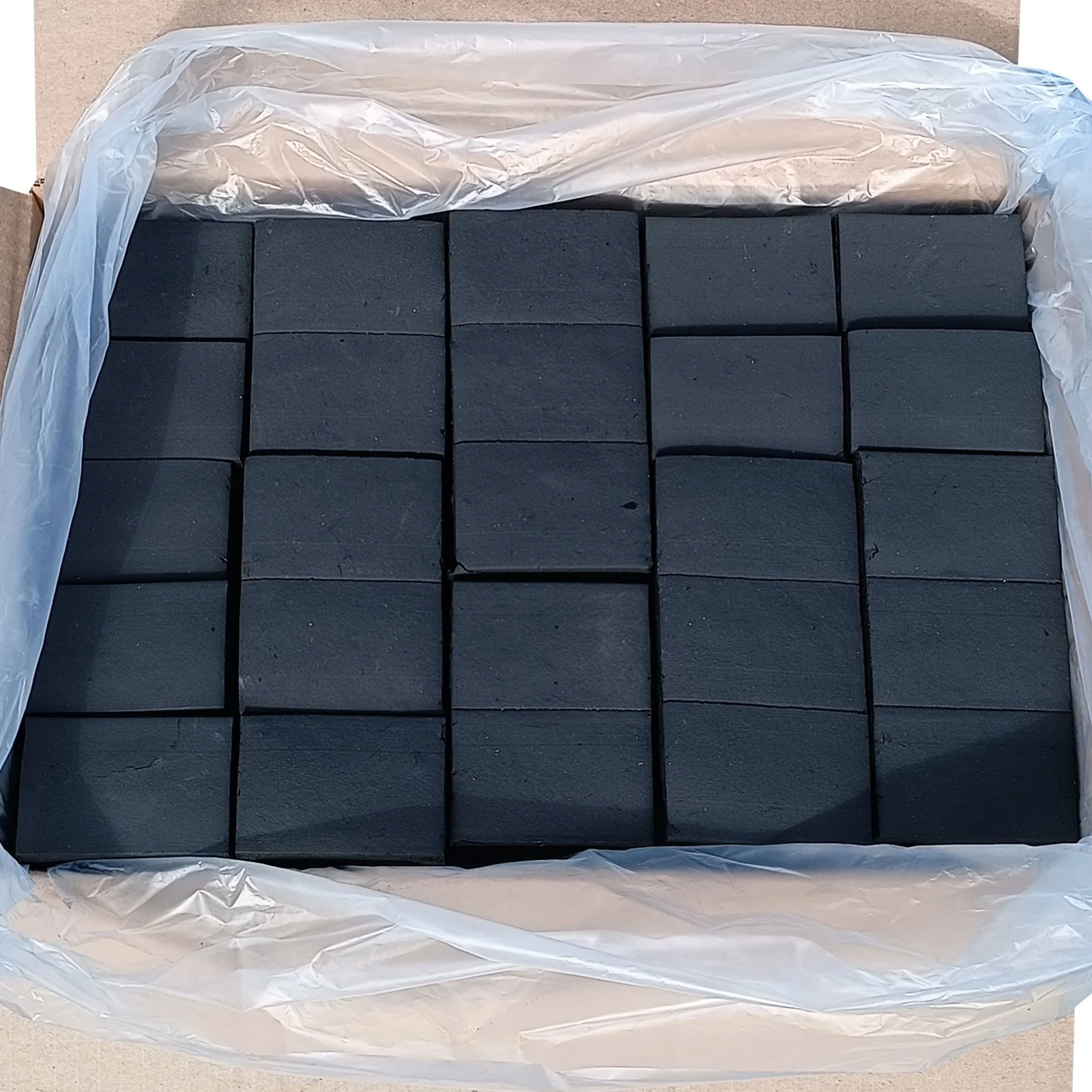
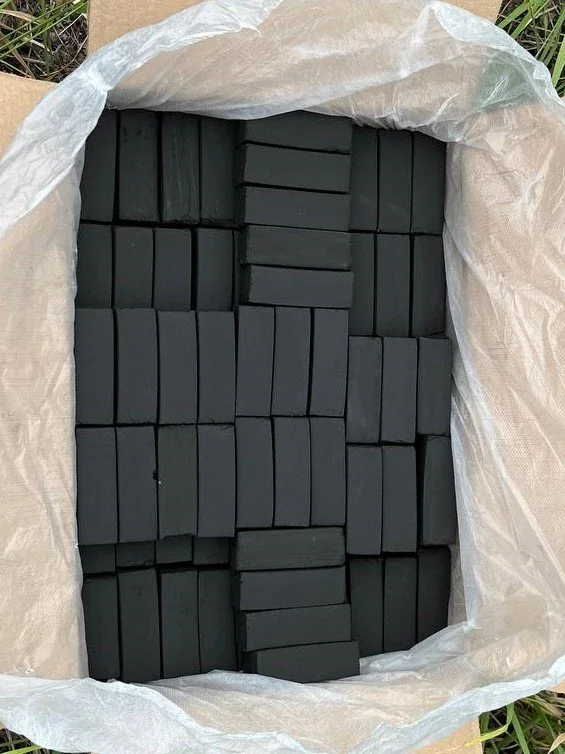
In an extruder the process looks completely different. Instead of two rollers, the work is done by a powerful screw. It continuously forces the charcoal mass through a forming die at a significantly higher pressure. The material also stays under load for much longer.
On top of that, strong internal friction develops. It slightly heats the blend, helps drive off part of the residual moisture and compacts the future briquette even further. What comes out is a practically monolithic charcoal bar of very high density. Such a material bears far less resemblance to merely compressed powder — in its properties it is closer to a single body of carbon.
Why hookah charcoal is almost always made on extruders
A curious fact known to far from everyone: virtually all high-quality professional hookah charcoal is produced by extrusion. The reason is simple. A hookah places very tough demands on charcoal — high density, maximum strength, a long burn, high temperature, steady heat output and minimal crumbling. If hookah charcoal falls apart quickly or burns through fast, it is unusable. That is why manufacturers around the world committed to extruder technology long ago — in effect it was the hookah market that proved its advantages.
We applied this technology to grill charcoal
Most producers of grill briquettes still use roller presses. We took a different path: we took the technology that has been used successfully for decades to make premium hookah charcoal and adapted it for cooking on the grill. The result is dense extruded briquettes designed not for a hookah bowl but for the serious thermal load of cooking meat, fish, vegetables and grilled dishes.
What happens inside a briquette while it burns
For most buyers the process looks the same: put the briquette in a chimney starter, light it, wait for the heat and start cooking. But at that very moment a complex physical process is under way inside the charcoal briquette, and it depends directly on how densely the briquette was made.
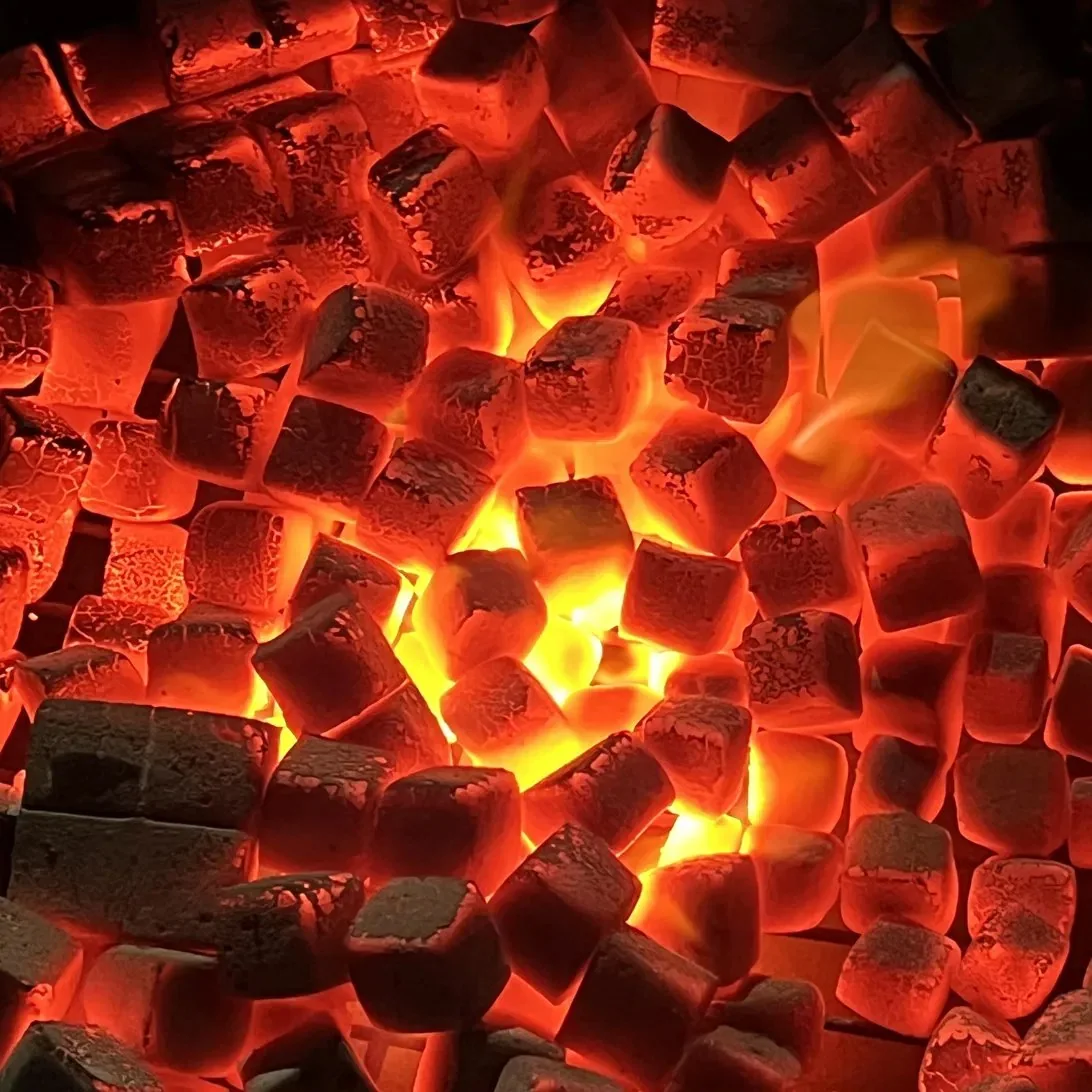
When a briquette enters a high-temperature zone, its outer layers are the first to heat up. If the material is loose and full of voids, air quickly penetrates inside: there is more oxygen, and combustion develops more intensively. Such a briquette reaches its working temperature faster, but it starts to lose mass just as fast. That is why less dense products often flare up brightly and then turn to ash fairly quickly.
An extruded briquette has a considerably denser structure. Heat spreads gradually — from the surface to the centre. The result is a kind of accumulator of thermal energy: a glowing layer of charcoal has already formed on the outside while the inner volume keeps storing heat. That is why, once fully lit, an extruded briquette can hold an almost constant temperature for a long time, and the cook does not have to keep making up for a drop in heat with a fresh portion of fuel.
During use the surface gradually becomes covered with a thin layer of ash. If the briquette itself is dense enough, this layer stays stable and does not destroy the shape of the product, while the glowing carbon core keeps working for a very long time. That is why good extruded briquettes often look like solid glowing blocks even an hour into cooking — an effect well known to anyone who has used quality hookah charcoal.
Imagine two pieces of wood of the same weight: one loose, the other very dense. The loose material takes up oxygen faster and burns out faster; the dense one resists the process far longer. Almost exactly the same happens with charcoal briquettes: the denser the structure, the more slowly oxygen penetrates inside, the more evenly the carbon oxidises and the more stable the temperature. That is why high density almost always means a longer working time.
When cooking shashlik the difference may not be particularly noticeable. But move on to more demanding dishes — thick steaks, large cuts of pork, brisket, ribs, turkey, vegetables on a long grill session — and the advantages become obvious. Dishes like these need steady heat for an hour or more, and this is exactly where extruded briquettes make cooking far more comfortable.
How an extruded briquette differs in use
Our extruded briquettes have a considerably denser structure, crumble less in transit, give a powerful and even heat, hold their working temperature longer, burn through more evenly and are more convenient for long cooking. The difference is especially noticeable when working with large cuts of meat, steaks, shashlik, brisket or dishes that need steady heat over a long period. Instead of constantly adding fuel, you can concentrate on the cooking.
◯ Roller press
▮ Extruder
| Parameter | Roller press | Extruder |
|---|---|---|
| Technology | two rollers compress the mix | a screw forces the mix through a die |
| Pressure | lower | significantly higher |
| Pressing time | fractions of a second | significantly longer |
| Briquette density | medium | very high |
| Strength | may crumble | high |
| Amount of dust | usually more | significantly less |
| Heat duration | medium | longer |
| Temperature stability | gradually declines | stays almost unchanged for a long time |
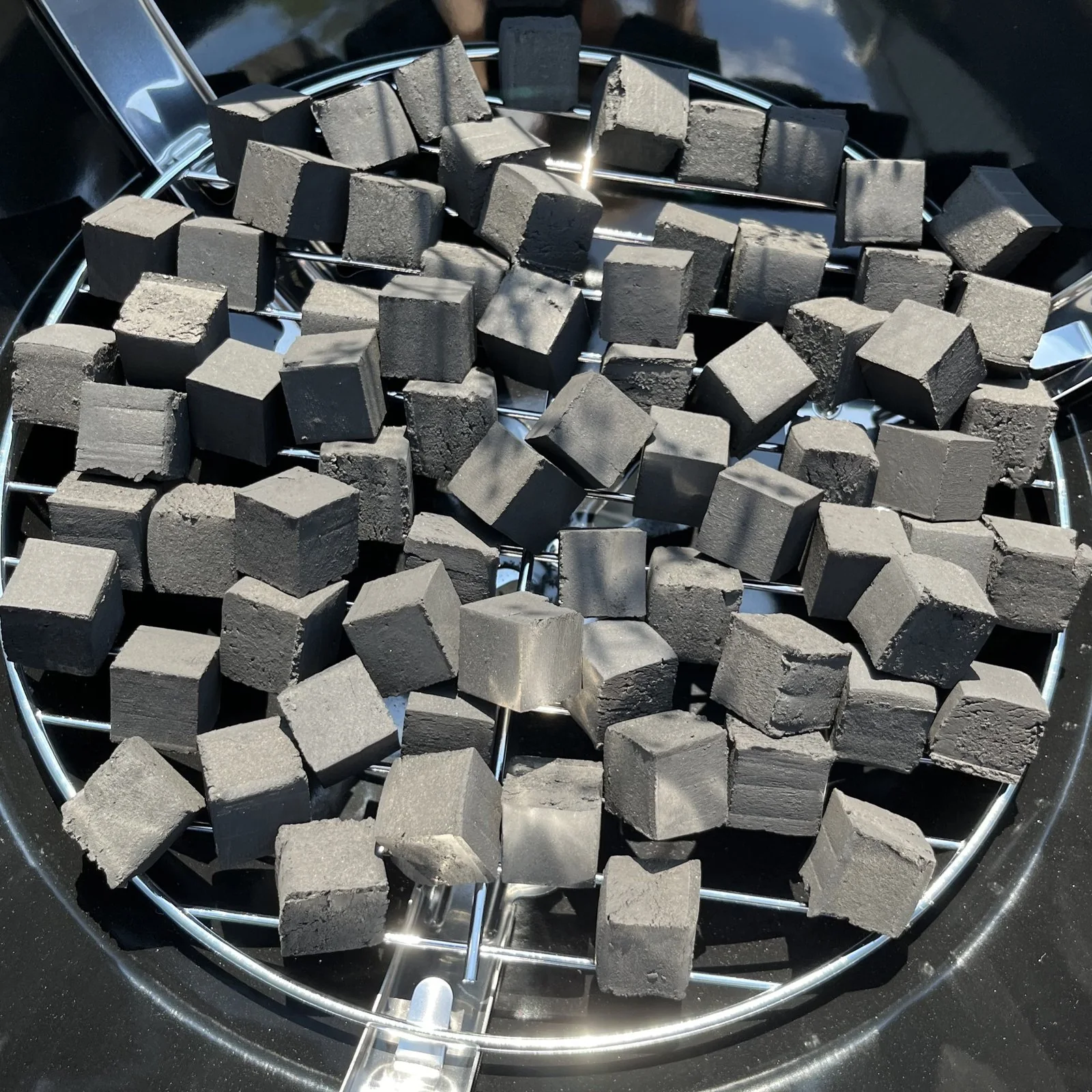
| Shape | oval "pillows" | cubes, bars, sticks |
| Typical applications | mass market | hookah charcoal and professional briquettes |
- how much heat the charcoal will accumulate;
- how long it will release that heat;
- how strong it will be;
- how much dust will be left in the bag;
- how many times you will have to add more charcoal while cooking.
Our extruded briquettes
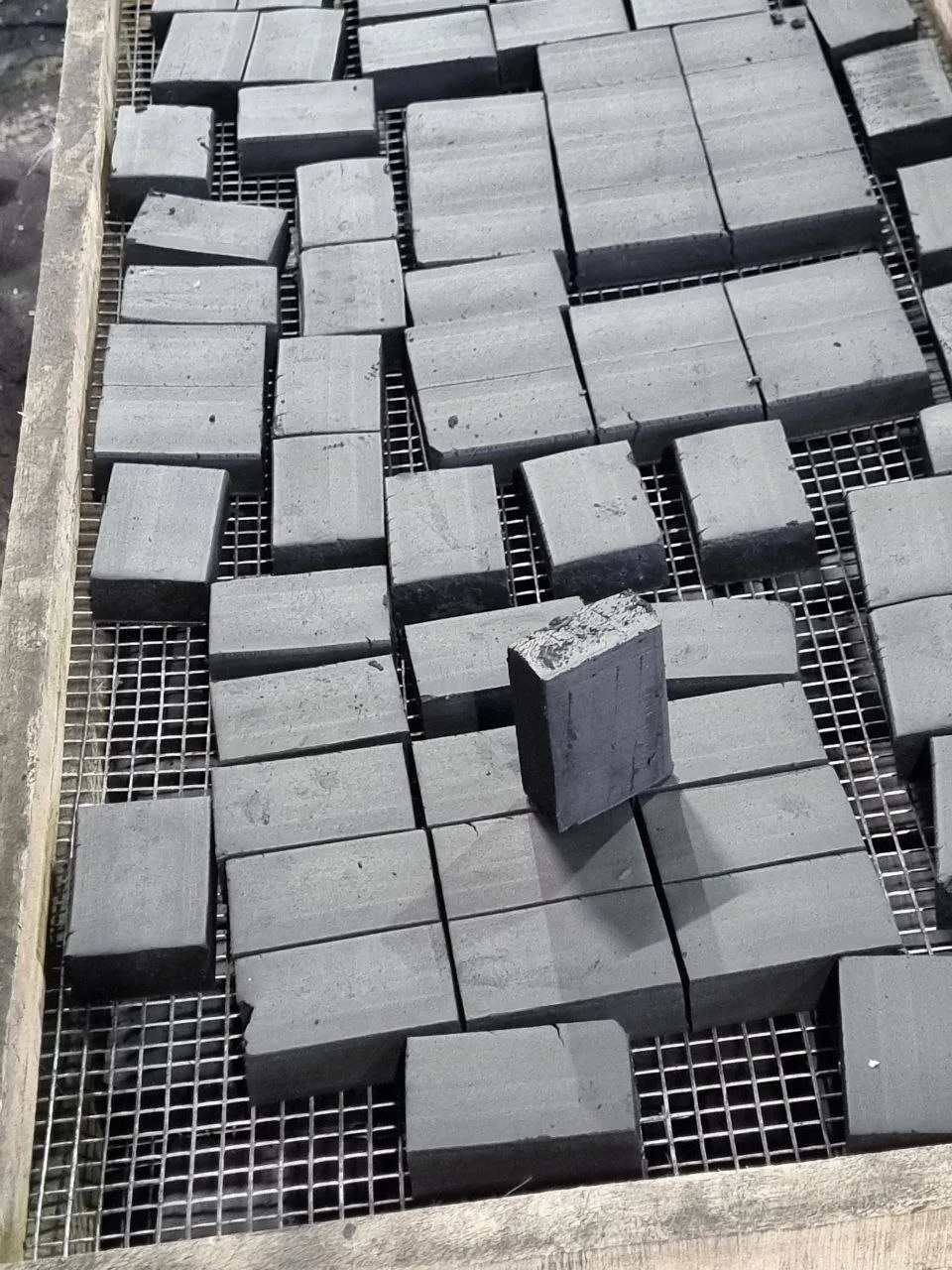
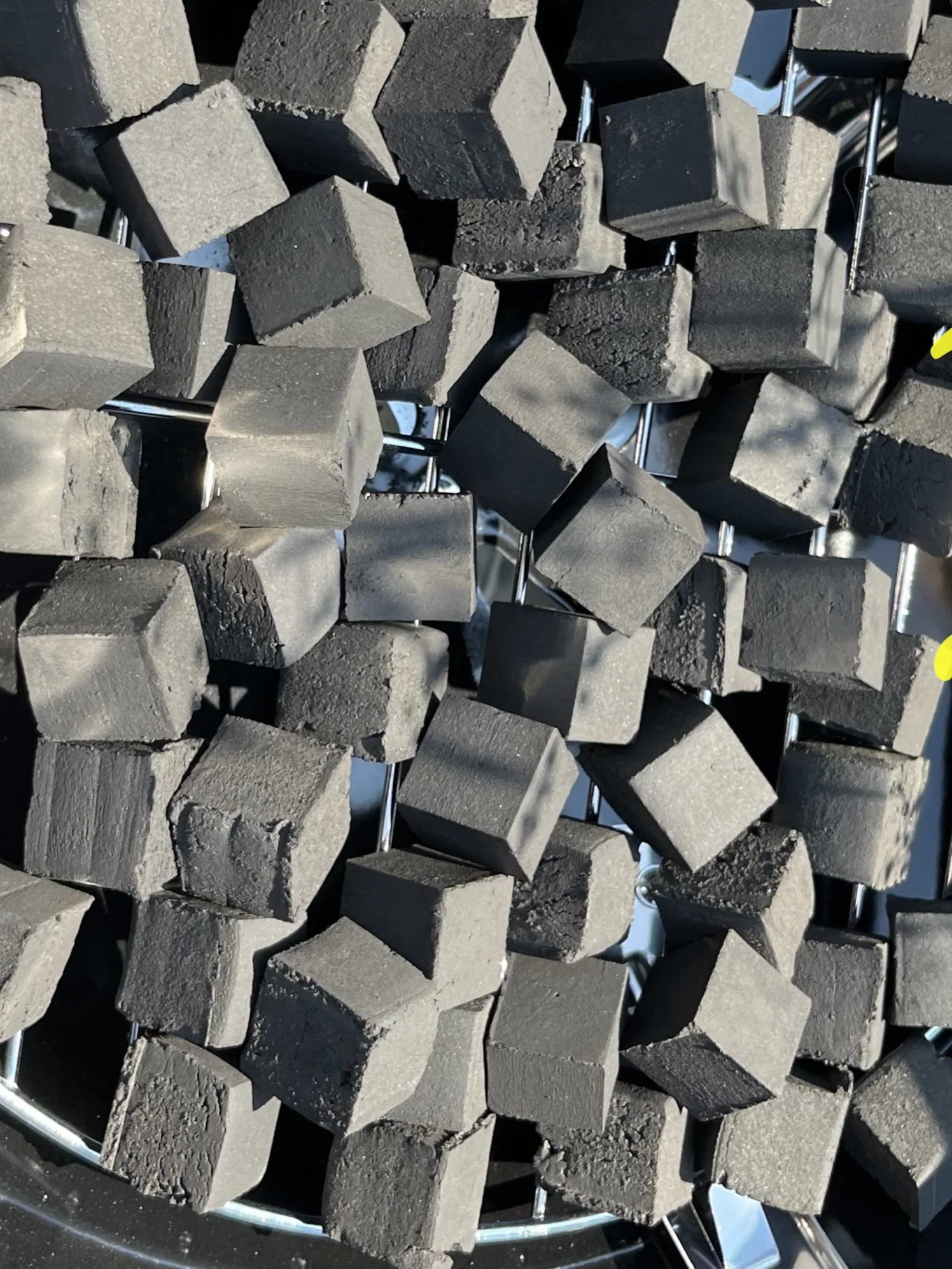
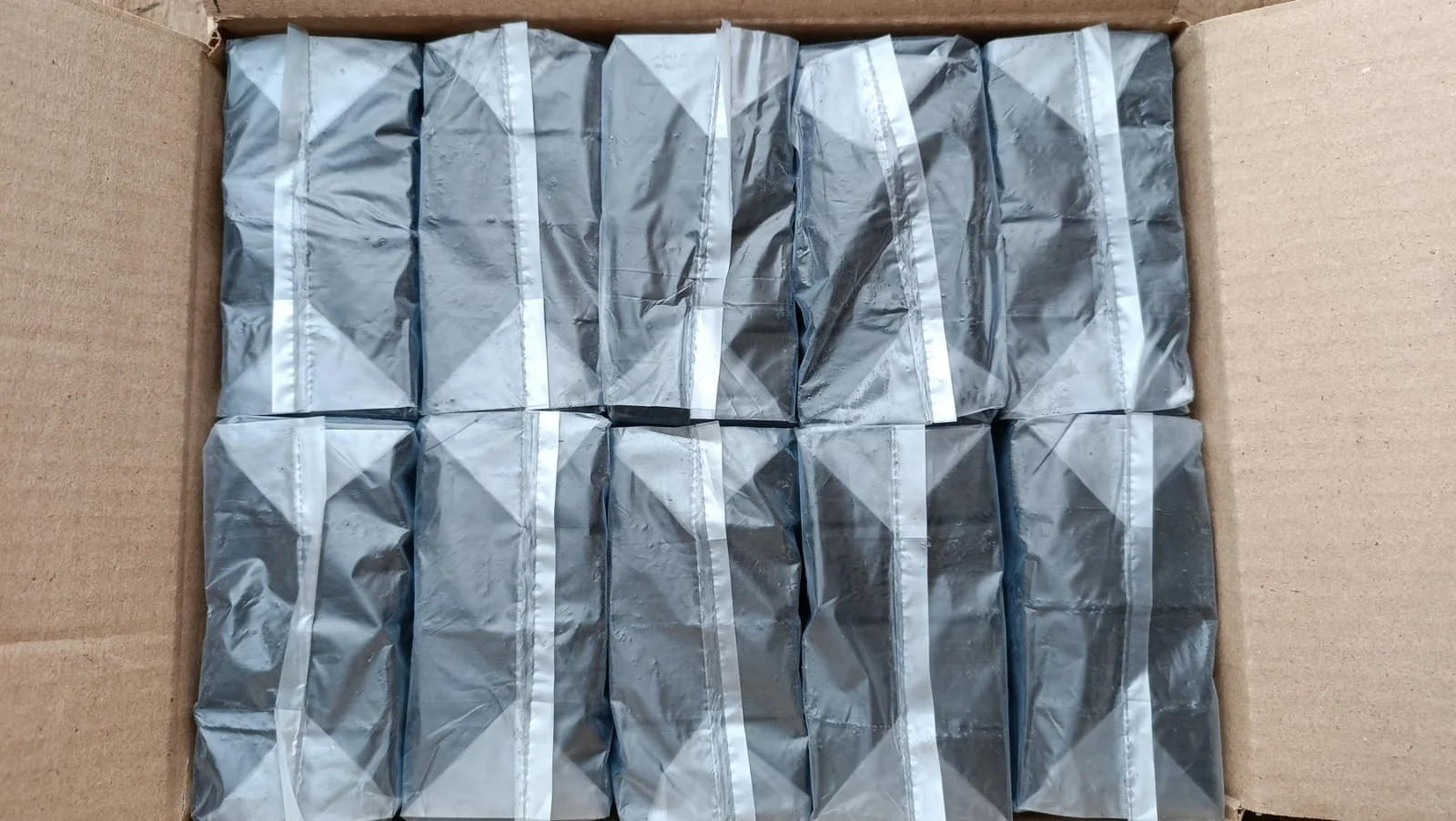
Thanks to their high density, extruded briquettes have a distinctive geometry: even edges, virtually identical dimensions and easy stacking in the grill. The dense structure helps them accumulate a large amount of thermal energy and then release it gradually during cooking. In use, the briquette does not break down instantly but turns evenly into a red-hot monolith of charcoal, maintaining a stable temperature. This is exactly what professional chefs and fans of long grill cooking value most.
What is hidden inside the briquette
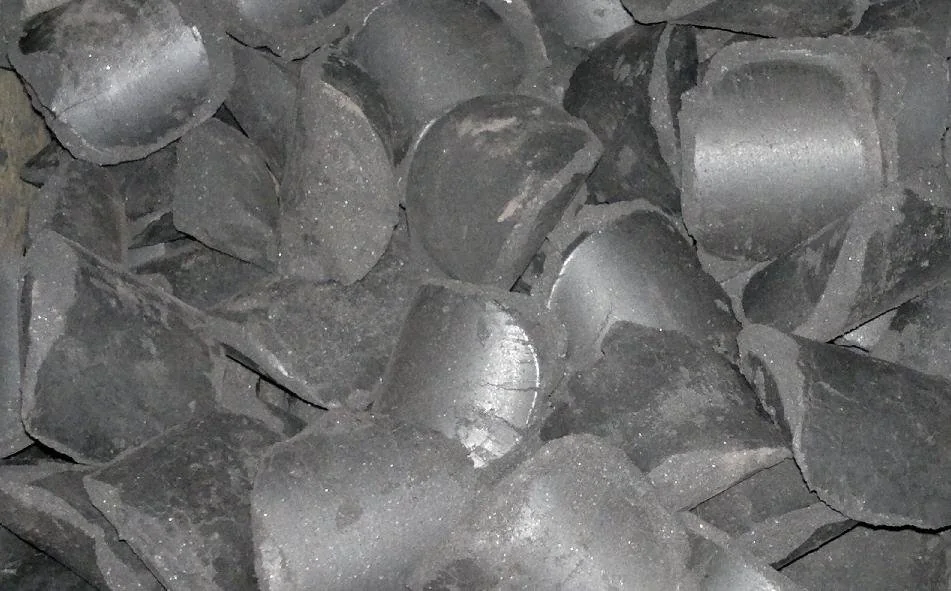
Beneath the black outer surface there are two completely different structures. To see this, it is enough to compare the materials up close.
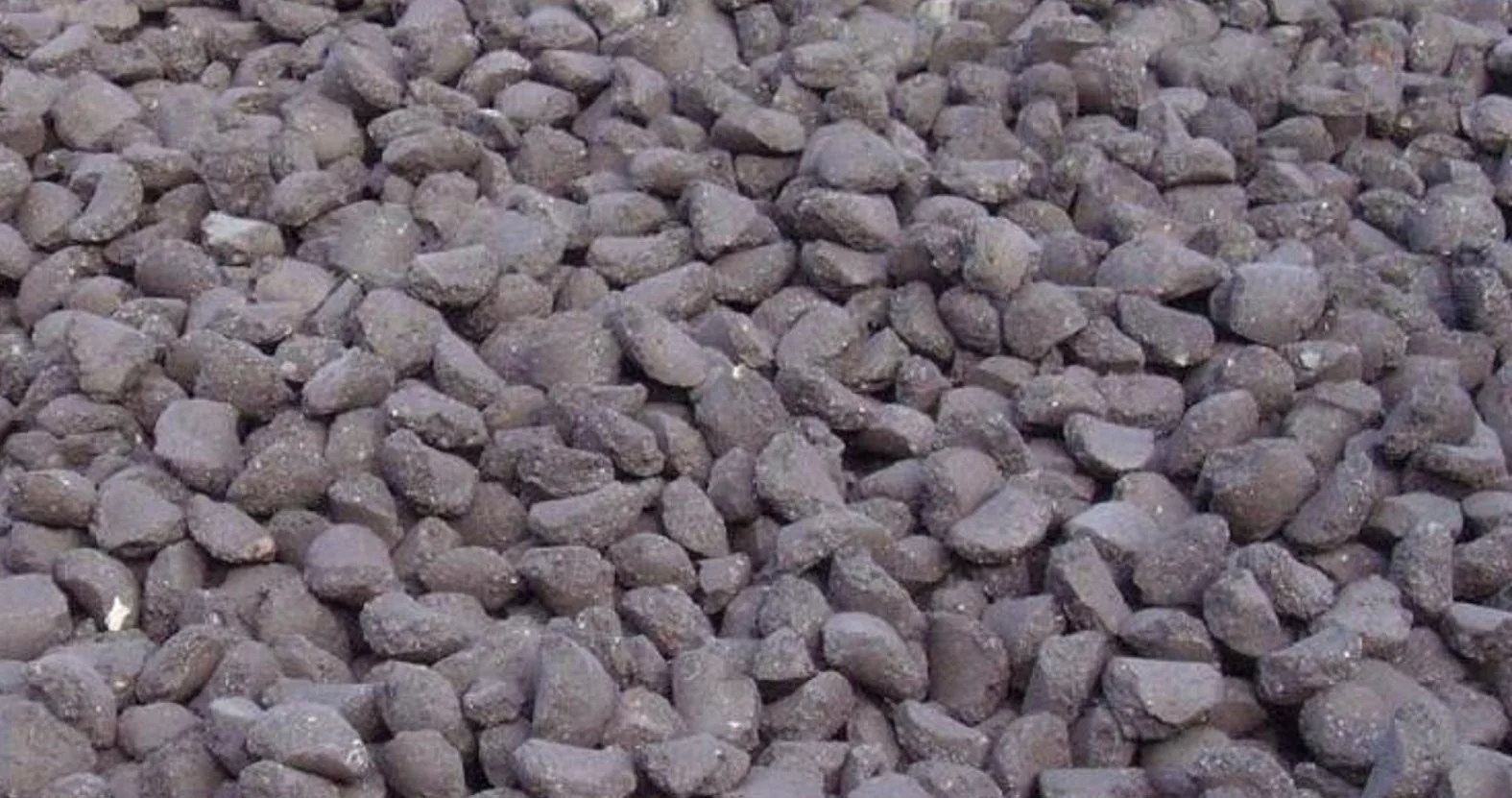
◯ Roller-pressed briquette
- a looser structure;
- visible pores;
- non-uniform material;
- a higher chance of cracks forming.
▮ Extruded briquette Ω
- a virtually monolithic structure;
- dense sintering of the particles;
- a minimum of voids;
- even texture and high strength.
Imagine two sponges: one loose and one very dense. If you push air through them, the first will offer almost no resistance, while the second will let the air through much more slowly. Much the same happens with a charcoal briquette: during combustion oxygen gradually penetrates into the material, and the denser the structure, the slower the carbon oxidises. That is exactly why extruded briquettes are able to hold their working temperature significantly longer.
Myths about charcoal briquettes
There are many persistent misconceptions in the charcoal market. Let's look at the most common ones.
Not quite. The weight of the packaging says nothing about the quality of the briquette itself. What matters is density, carbon content, ash content and mechanical strength. Sometimes a lighter but denser extruded briquette performs better than a heavier, looser one.
This is probably the most widespread misconception. In practice, the production technology, the pressing pressure, the raw material composition, the charcoal quality, the amount of binder, the moisture content and the density all differ. That is exactly why two briquettes that look alike can behave in completely different ways.
Fast ignition is by no means always a sign of good charcoal. If a briquette heats up too quickly, it often loses that heat just as quickly. For cooking, the duration of stable heat matters far more — that is what determines how comfortable the cooking process is.
At first glance this seems logical, but the opposite is true. If a manufacturer has to keep increasing the amount of binder, it often means that the structure itself is not dense enough. An extruder achieves high strength primarily through strong compaction of the material, not just through adhesive components.
In reality the shape almost always reveals the production technology. Oval "pillows" nearly always indicate roller pressing; rectangular bars, sticks or cubes are most often the result of extrusion. Shape is a consequence of the manufacturing method, not a design decision.
No. High strength is more often explained precisely by the high density of the material. A quality extruded briquette can withstand transportation without producing much dust thanks to its structure, not thanks to "secret additives".
Not necessarily either. What you should compare is not the price per pack but the cost of an hour of stable heat. If cheap briquettes have to be topped up constantly, their real consumption may turn out to be higher. Sometimes better charcoal proves more economical precisely because it burns longer.
Frequently asked questions
Why do extruded briquettes cost more?
Why do most manufacturers still use roller presses?
Why is hookah charcoal almost always made on extruders?
Why is this technology rarely used for grill briquettes?
How is an extruded briquette better for cooking meat?
How can you tell the production technology from the appearance?
Conclusion
At first glance the difference between an oval "pillow" and a rectangular bar looks like a matter of design. In fact the shape merely reflects the production method. The roller press was created as a technology for fast, high-volume output. The extruder is a more complex and energy-intensive process that makes it possible to obtain the densest and strongest charcoal briquette. That is exactly why the extruder has long been the standard for quality hookah charcoal, where long burning, high temperature and stable heat output are especially important.
We have brought this technology into the production of grill briquettes. The result is charcoal that combines high mechanical strength, stable heat and long burning — qualities that are noticeable not on the shop shelf but while you are cooking on the grill.
Sources
- Review of biochar briquetting (screw press density 1000–1400 kg/m³). ScienceDirect (2024). sciencedirect.com/science/article/pii/S0959652624026428
- Extruder vs. roller press: higher pressure, less binder, bar shape. Briquette Solution. briquettesolution.com/extrusion-briquette-maker
- Types of briquetting machines: roller press for mass-market BBQ, screw extruder for premium bars. Durable. durablemac.com
- Techno-economic review of the screw press. IntechOpen (2024). intechopen.com/chapters/1204788