Biochar in real life
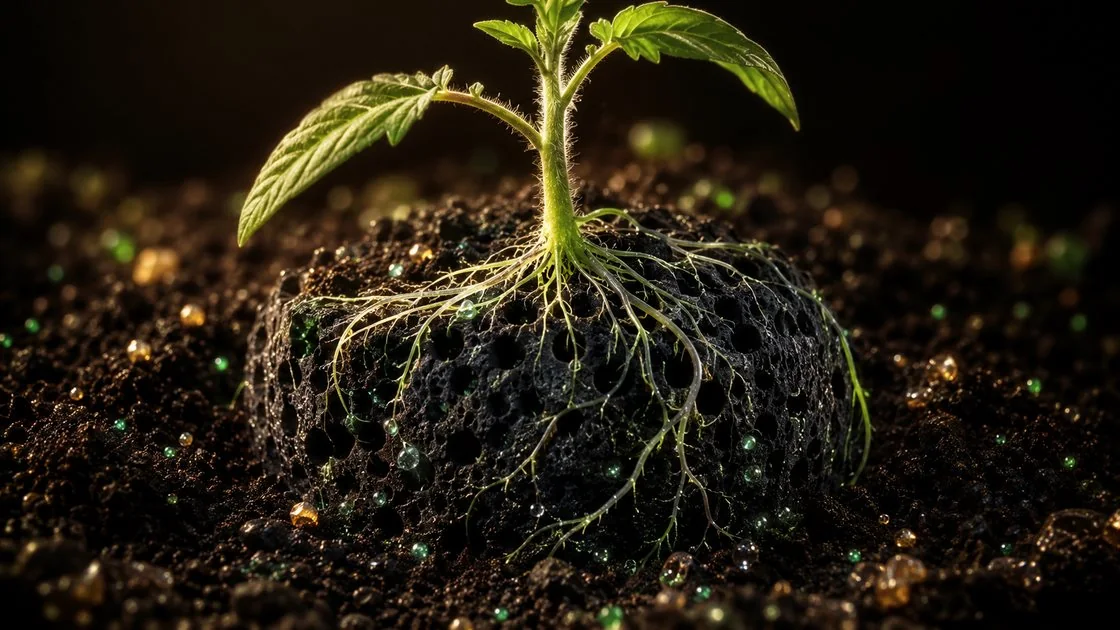
Chapter one. The story of a single granule
Imagine a small black granule lying in the palm of your hand.
It weighs almost nothing.
It does not shine.
It has no sharp smell.
At first glance it seems to be an ordinary piece of charcoal.
But if this granule could tell its story, it would turn out to be far longer than a human life.
Once it was a tree.
Even earlier it was sunlight, which the leaves turned into wood.
Then it passed through pyrolysis, preserving inside itself the astonishing architecture of millions of microscopic pores.
Now its new life begins.
Not at all like the previous one.
Today
The bag is open.
The granules are scattered over the surface of the ground.
Within a few minutes they end up in the soil.
From this moment a process begins that cannot be seen with the naked eye.
But it is this process that will determine everything that happens next.
The first hour
Soil is never motionless.
Even when it seems completely dry.
Water molecules are constantly moving between its particles.
Dissolved mineral substances.
Organic compounds.
Millions of microorganisms.
The pores of the biochar are still empty.
They resemble a new house in which no one has yet settled.
Water is the first to find the entrance.
Under the action of capillary forces it begins to penetrate inside.
Dissolved salts follow.
Organic acids.
Humus molecules.
The granule gradually ceases to be merely carbon.
It becomes part of the soil.
The first day
If you looked at this process under an electron microscope, you would see a remarkable picture.
The thinnest film of water already covers the inner walls of most of the large pores.
The first organic molecules appear on the surface.
Some of them are held so firmly that they remain there for a long time.
One might say that the granule begins to acquire a memory of its own.
Every new rain.
Every watering.
Every application of fertiliser.
Leaves a small trace inside it.
Over time there are more and more such traces.
The first guests
Soil is never empty.
Even a small clod of earth is home to billions of microorganisms.
Most of them are so small that it is impossible to imagine their size.
Some are able to cover a distance equal to their own body length faster than a person runs the hundred-metre dash.
They are the first to discover the new territory.
To a bacterium the pores of biochar look like enormous caves.
Stable moisture.
Sheltered walls.
A constant inflow of dissolved substances.
An almost ideal place to live.
The first colonies begin to establish themselves within the very first twenty-four hours.
Why no one lives on bare stone
There is a simple rule in nature.
Life more readily colonizes surfaces that offer something to hold on to.
A smooth glass bead is a poor place for microorganisms.
Rough wood is considerably better.
Biochar has an incredibly well developed microrelief.
Every wall is pitted with protrusions, hollows and microscopic cracks.
For bacteria this is a real landscape.
Here one can gain a foothold.
Hide.
Form a colony.
Begin to divide.
In this way a lifeless granule gradually turns into an inhabited world.
Dozens of different microbial communities can exist simultaneously on the surface of a single biochar granule. Each occupies its own microscopic "neighborhoods" and plays its own role in the life of the soil.
The first week
By this point the granule is already hard to recognize.
No, outwardly it has hardly changed.
But inside there is vigorous life.
The number of microorganisms increases.
The first stable biofilms form.
Fungal hyphae appear.
Some pores are already completely filled with water.
Others contain air.
A remarkable combination of conditions arises.
Some microorganisms prefer moist areas.
Others — drier ones.
Each finds its own niche.
It is precisely this diversity of conditions that makes biochar so attractive to soil life.
The first encounter with a root
Meanwhile a young plant root is developing nearby.
It does not grow at random.
Roots are able to sense their environment far better than it might seem.
They respond to moisture.
To the concentration of nutrients.
To the chemical signals released by microorganisms.
As it approaches a biochar granule, the root finds itself as though beside a small oasis.
Here moisture changes more slowly.
Here biological activity is higher.
Here there are more compounds available for nutrition.
The root begins to branch.
It forms a multitude of the finest root hairs.
This is how the first real contact between the plant and the granule arises.
It is already working
Curiously, the granule itself does nothing in the usual sense of the word.
It does not produce fertiliser.
It does not create water.
It does not synthesize nutrients.
It merely creates conditions in which all natural processes begin to run a little more efficiently.
That is why the action of biochar is hard to notice at any one particular moment.
There is no day on which the soil suddenly becomes ideal.
There are thousands of small changes.
Each of them is almost imperceptible.
But together they gradually change the whole system.
That is exactly how a forest changes.
That is how a garden matures.
That is how fertile soil is formed.
Not instantly.
But day after day.
Ahead — the first season
Only a week has passed.
For a human being that is almost nothing.
For microorganisms — a whole epoch.
But the most interesting part is only beginning.
The first summer lies ahead.
The first drought.
The first heavy rains.
The first applications of fertiliser.
It is they that will show how a small black granule gradually becomes part of the living soil and begins to influence the fate of plants for many years to come.
Chapter two. The first season. How the soil begins to change
A month has passed.
Outwardly the granule has hardly changed.
If you dig it out of the ground, it will be just as black and light.
You might even decide that nothing special has happened.
But this impression is deceptive.
Most of the processes that determine soil fertility cannot be seen at all without special instruments.
We do not see how water moves between microscopic pores.
We do not notice the chemical reactions on the surface of soil particles.
We are unable to observe the billions of microorganisms working around the clock.
That is why the changes seem imperceptible.
Although in fact they are already under way.
When the heat arrives
Imagine two neighboring plots.
The same plants grow on both.
The soil is of the same composition.
The same irrigation.
But then comes a week without rain.
During the day the temperature exceeds thirty degrees.
The upper layer of soil dries out quickly.
For the plants an ordeal begins.
Water evaporates faster than the roots manage to take it up.
The leaves gradually lose their turgor.
Growth slows down.
If the drought continues, the plant begins to conserve moisture.
The stomata of the leaves close.
The intensity of photosynthesis decreases.
Every day becomes a struggle for survival.
Invisible reservoirs
Now let us return to our granule.
We already know that its internal pores retain part of the water.
It is important to understand: biochar does not create additional moisture.
It cannot replace watering or rain.
But it helps to retain part of the water that has already entered the soil.
Imagine two identical houses.
One has a small storage tank installed.
The other does not.
When the water supply is cut off, the residents of the first house can go on using the reserve for some time.
In the second the water runs out almost immediately.
The micropores of biochar work in a similar way.
They become small internal reservoirs from which moisture gradually returns to the surrounding soil as it dries out.
This does not save plants from a prolonged drought.
But it helps them get through short periods of moisture deficit more easily.
That is why in studies biochar is often associated not so much with an increase in the amount of water as with more efficient use of the water already present.
After heavy rain
Interestingly, the opposite situation matters too.
After a downpour some soils literally turn into mush.
Water fills all the free spaces.
There is less air.
The roots begin to experience oxygen starvation.
Then the heat comes.
The soil dries out.
A dense crust forms.
This cycle repeats again and again.
Biochar granules help to make such swings less abrupt.
Their solid carbon framework supports the internal structure of the soil.
Air penetrates more easily to the roots.
Water is distributed more evenly.
The soil becomes more resistant to alternating waterlogging and drying out.
Of course, biochar alone cannot completely change the properties of heavy clay or loose sand.
But together with organic matter and living microflora it becomes part of a process that gradually improves soil structure.
Losses that go unseen
When a gardener applies fertiliser, it seems that it stays in the ground.
In fact a significant part of it begins its journey almost immediately.
Some compounds dissolve easily in water.
After heavy rain they can move deeper, beyond the zone where the main roots are located.
Some of the elements enter into chemical reactions and become less available to plants.
Some are used by microorganisms.
These are natural processes.
It is impossible to stop them.
But they can be made more manageable.
This is where biochar comes into play again.
Its highly developed surface helps to temporarily retain part of the dissolved nutrients, reducing the rate of nutrient leaching.
It is important to emphasize: this is not about completely preventing leaching.
Rather it is about creating a kind of "buffer" that allows nutrients to remain in the root zone longer.
In modern agrochemistry increasing use is made of the concept of nutrient use efficiency. It shows not only how much fertiliser has been applied but also what proportion of it was actually taken up by the plants. In many cases it is precisely an increase in this efficiency that proves more important than simply increasing the fertiliser rate.
The roots begin to explore new territory
For a plant, soil is a vast, almost unexplored world.
Roots grow constantly, exploring the surrounding space.
But they do not move at random.
They respond to moisture.
To the oxygen content.
To the concentration of dissolved substances.
To the chemical signals released by soil microorganisms.
Where conditions are more favourable, the root system usually develops more actively.
If a biochar granule already colonized by microflora and saturated with moisture is nearby, it becomes a kind of local centre of activity.
This does not mean that roots "look for biochar".
They simply develop where the environment turns out to be more comfortable.
There are gradually more and more such small zones in the soil.
It is from a multitude of such microscopic changes that the overall picture of a healthy root system is built up.
The soil becomes more resilient
By the end of the first season a change occurs that is hard to measure with a ruler but easy for an experienced agronomist to notice.
The soil begins to behave differently.
After rain it restores air exchange more quickly.
After drought it loses the remaining moisture more slowly.
Roots penetrate deeper.
There are more microorganisms.
Organic residues decompose more evenly.
All these changes are small in themselves.
But they reinforce one another.
It is like a well-tuned orchestra.
No single instrument plays the leading role.
But together they create music.
In the same way soil fertility is born not from a single miraculous property but from the coordinated work of many processes.
The first harvest
And now the time comes to harvest.
It is often here that plot owners ask the main question:
"So where is the result?"
Sometimes it really is noticeable in the very first season.
Especially on poor, degraded or light sandy soils, where the improvement in the water regime and in structure shows up faster.
But it can also be otherwise.
On fertile land the changes may be barely noticeable.
And this by no means implies that the biochar "did not work".
Many of the processes it sets in motion are designed not for one season but for years.
Perhaps this is precisely what distinguishes biochar from most familiar agronomic practices.
It does not aim to give an instant effect.
It gradually changes the very environment in which the plants will grow.
And the longer this process continues, the more noticeable its results become.
Ahead — years of work
The first season is over.
For most fertilisers the story practically ends there.
But for our little granule everything is only beginning.
In a few years it will no longer be a separate material but part of the soil structure.
Stable microbial communities will form around it.
Organic matter will begin to bind into strong soil aggregates.
It is then that it will become clear why specialists increasingly call biochar an investment not in one year's harvest but in the fertility of decades to come.
That is what the next chapter will be about.
Chapter three. Several years later. How a new soil is born
There are processes that happen quickly.
After rain the ground becomes wet.
After frost — hard.
After ploughing — loose.
But there are changes that cannot be seen within a single season.
They occur so slowly that they become noticeable only when you look back.
The formation of true fertility is precisely such a change.
Soil is able to mature
When people speak of the age of a garden, everything is clear.
There are young trees.
There are mature ones.
There are hundred-year-old ones.
But few people consider that soil also has a history of its own.
Two plots may look identical.
The same crop may grow on them.
The same area.
The same climate.
But one plot will get better year by year.
While the other gradually loses its fertility.
The difference lies not only in the amount of fertiliser.
The main distinction is hidden considerably deeper.
In the structure of the soil itself.
What good structure is
Take a handful of fertile forest soil in your hands.
It does not crumble into dust.
But nor does it turn into a heavy lump.
It consists of many small aggregates — stable crumbs of various sizes.
Air gaps remain between them.
Water moves through them.
Roots penetrate.
Microorganisms breathe.
It is precisely this structure that soil scientists call one of the most important foundations of fertility.
Interestingly, it does not appear by itself.
It is literally built by life.
Millions of small builders
If it were possible to watch soil in time-lapse over several years, the picture would be unexpected.
Bacteria secrete sticky polysaccharides.
Fungal hyphae wrap around soil particles like the finest of nets.
Plant roots grow through the tiniest pores.
Earthworms create channels.
Organic residues gradually turn into humus.
Together, these processes bind individual mineral particles into stable aggregates.
Biochar becomes part of this architecture.
It does not direct the construction work.
But it becomes a durable framework around which a new structure gradually forms.
Why humus does not appear instantly
Sometimes you hear the phrase:
"Add organic matter and the soil will become fertile."
In reality, humus formation is one of the slowest processes in nature.
Organic residues first decompose.
Then they are processed by microorganisms.
Part of the carbon returns to the atmosphere.
Part is converted into stable humic compounds.
This process takes years.
Biochar does not miraculously speed it up.
But it helps retain organic matter exactly where it brings the greatest benefit — in the root zone.
That is why the changes become more and more noticeable with every new season.
Soil is one of the largest carbon reservoirs on Earth. According to current estimates, it stores more carbon than all of the world's vegetation and the atmosphere combined. This is precisely why even small changes in organic matter content matter not only for yields, but also for the global carbon cycle.
When soil begins to help itself
After several years, an effect appears that experienced agronomists particularly value.
The system becomes more resilient.
After heavy rain it recovers faster.
After drought it loses moisture more slowly.
Microorganisms survive unfavourable periods more easily.
The root system explores the soil more deeply.
Each following season no longer starts "from scratch".
The soil gradually accumulates experience of its own.
Of course, this is only a figurative comparison.
But it conveys the essence of what is happening rather well.
Fertility stops depending solely on what was applied this spring.
What happened here over the previous few years matters more and more.
An investment that is not visible right away
Modern farming often demands quick results.
A fertiliser application should take effect within a few days.
A crop protection product — within a week.
But there are solutions of a different kind.
They are not designed for an instant effect.
They work slowly.
But for a very long time.
Biochar belongs precisely to this kind of solution.
That is why specialists increasingly call it not a consumable, but an investment in soil quality.
Gardeners understand this approach especially well.
Having planted a young orchard, no one expects a maximum harvest a year later.
Everyone knows that a real garden takes decades to create.
Almost the same thing happens with soil.
Ten years later
Let us picture our granule once again.
Ten years have passed.
The tree it was once made from disappeared long ago.
Over this time the field has been through many seasons.
There were droughts.
There were downpours.
There were frosty winters.
And hot summers.
Thousands of roots have grown around the granule.
Countless generations of bacteria have come and gone.
Some mycelia died.
Others appeared.
But the granule itself is still part of the soil.
It continues to hold water.
To support microorganisms.
To serve as a basis for the formation of new soil aggregates.
This is one of the most unusual features of biochar.
It is designed not for a season.
It is designed for years.
Sometimes — for decades.
Chapter four. Where biochar is already at work
When biochar comes up, many people picture an ordinary garden plot.
A few beds.
A greenhouse.
Fruit trees.
But today the geography of its use is far wider.
And sometimes completely unexpected.
Orchards planted for decades ahead
A fruit orchard is rarely established for a single season.
Apple, pear, cherry and nut crops can grow in one place for decades.
That is why growers pay particular attention to soil quality at the moment the orchard is planted.
Mistakes made at the very beginning are then very hard to correct.
This is exactly why materials capable of improving soil structure over the long term attract particular interest here.
Vineyards
Good wine begins long before the harvest.
It begins with the soil.
Grapevines have a deep root system and are able to exploit large volumes of soil.
Structural stability, the water regime and the development of soil biota are therefore of great importance for them.
It is no coincidence that research on the use of biochar in viticulture is being actively pursued in many countries with a developed winemaking culture.
Modern greenhouses
High-tech greenhouse complexes resemble laboratories.
Automated irrigation.
Temperature control.
Metered nutrition.
Computer-controlled microclimate.
Here the ability of substrates to maintain stable properties and to efficiently retain moisture and nutrients is especially valued.
This is why biochar is increasingly regarded as a component of modern soil mixes and substrates.
Reforestation
After fires, logging or the reclamation of disturbed land, young trees face harsh conditions.
The soils are often poor in organic matter.
They dry out quickly.
They have a damaged structure.
In projects like these, biochar is seen as one of the ways to improve the resilience of young plantings at the early stage of their development.
Urban trees
The conditions of a large city can hardly be called comfortable for plants.
Compacted soil.
High asphalt temperatures.
A limited volume of soil.
A shortage of moisture.
This is precisely why urban landscaping specialists are increasingly looking for materials that can help trees cope with stressful conditions more easily.
Biochar is becoming one of these solutions.
Bringing life back to disturbed land
Quarries.
Spoil heaps.
Construction sites.
Areas left after mineral extraction.
On sites like these, soil has to be created almost from scratch.
This is a long process that requires a combination of organic materials, pioneer plants, microbiological preparations and sound agronomic practice.
Biochar is regarded as one of the components of such restoration technologies.
And this is only the beginning
The most remarkable thing is that the list keeps growing.
Researchers are studying the use of biochar in water treatment, the production of construction materials, the creation of composites, the processing of organic waste, environmental filters and even new types of carbon materials for industry.
Every year brings new publications and new ideas.
Biochar was once merely a product of wood pyrolysis.
Today it is becoming a platform for a very wide range of engineering solutions.
The future lies ahead
And it is here that the story unexpectedly returns to its beginning.
The ancient inhabitants of Amazonia created fertile soil without suspecting that two thousand years later their experience would be studied by universities all over the world.
We already know how biochar works.
We understand why it helps the soil.
But the next question sounds even more interesting:
What will biochar be like twenty years from now?
The answer is in the final chapter of the article, where we will talk about digital farming, climate technologies, artificial intelligence and the future of fertility management.
Final chapter. A future that is already beginning
The story of biochar is remarkable if only because it develops in two directions at once.
On the one hand, it is one of the most ancient farming technologies known to humankind.
On the other, it is one of the youngest fields of modern agroecology.
New studies appear every year.
New materials are being created.
New ways of using it are being developed.
And it seems that the most interesting part is still to come.
When farming becomes an exact science
Not so long ago, a farmer assessed the state of a field literally by eye.
Experience.
Powers of observation.
Intuition.
These were what helped in making decisions.
Today agriculture is changing rapidly.
Drones fly over the fields.
Satellites photograph the crops daily.
Sensors continuously measure soil moisture.
A computer analyses the organic matter content.
Artificial intelligence is able to detect the first signs of plant stress before a human notices them.
This is no longer science fiction.
It is everyday practice on many modern farms.
Soil gets a digital map of its own
Picture a field of one hundred hectares.
It used to be seen as a single whole.
Today it turns out that even neighbouring areas can differ greatly.
In one place there is more sand.
In another the organic matter content is higher.
Somewhere water drains away faster.
Somewhere the soil is denser.
All these differences can be seen on a digital map.
And then the technology can be selected separately for each area.
This is exactly the approach that is called precision agriculture.
It makes it possible to work not with "average soil", which hardly exists in nature, but with the specific features of each individual field.
Biochar is becoming "smart" too
As digital farming develops, biochar itself is changing as well.
Until recently it was seen as a single material.
Today engineers increasingly design its properties in advance.
They select the feedstock.
They alter the pyrolysis regime.
They choose the particle size.
They activate it with specific organic compositions.
They colonise it with beneficial microflora.
They add mineral components.
The result is no longer a universal product, but a specialised solution for a specific task.
You could say that biochar is gradually following the same path once taken by fertilisers, seeds and farm machinery.
From universality — to precise tuning.
Artificial intelligence and fertility
At first glance it seems odd to link artificial intelligence and charcoal.
But this is exactly how agricultural science is developing today.
A computer is able to analyse vast amounts of information:
- soil properties
- climate data
- yield history
- the specific features of a particular crop
- irrigation regime
- the weather forecast
- laboratory analysis results.
On the basis of these data it is possible to select the most effective soil management technology.
This includes determining where the use of biochar will genuinely bring the greatest benefit, and where the expected effect will be minimal.
This approach makes agriculture not only more productive, but also more rational.
The new carbon economy
Another reason for the growing interest in biochar is connected with a change in the way carbon itself is viewed.
For a long time it was regarded solely as a source of emissions.
Today more and more attention is being paid to technologies that make it possible to reliably lock up atmospheric carbon for a long period.
Biochar has turned out to be one such material.
The carbon that a tree once took from the air through photosynthesis can, after pyrolysis, remain in the soil for decades and even centuries.
This is why biochar is mentioned more and more often in research devoted to sustainable agriculture and climate strategies.
It is important to understand that this is not a universal solution to climate problems.
But it is one of the real tools that can benefit both the soil and the plants at the same time.
International research regards biochar as one of the technologies for the long-term sequestration of biogenic carbon. Together with improving soil fertility, this makes it a focus of attention not only for agronomists, but also for specialists in climate policy, ecology and the circular economy.
A cycle that loses almost nothing
Modern industry increasingly uses the concept of the circular economy.
Its idea is simple.
Do not throw resources away after use.
Return them to a new production cycle instead.
Biochar fits this concept very well.
Plant residues.
Wood offcuts.
By-products of woodworking.
What used to become waste can be turned into a durable carbon material capable of working in the soil for decades.
The result is a kind of natural cycle.
The sun helps a tree to grow.
The tree becomes biochar.
The biochar improves the soil.
The soil again helps new plants to grow.
There is nothing artificial in this.
Rather the opposite — it is an attempt to use natural processes more intelligently.
What will remain a hundred years from now
Let us return to our little granule.
We have followed it through almost the whole article.
At first it lay in the palm of our hand.
Then it found itself in the ground.
It became a home for microorganisms.
It helped to get through the first droughts.
It became part of the soil structure.
Years went by.
Then decades.
And what next?
If this granule remains in favourable conditions, a significant part of its carbon framework will probably survive for a very long time yet.
Perhaps one day the archaeologists of the future will find it just as scientists today find patches of ancient Terra Preta in Amazonia.
And perhaps they too will ask themselves:
Why is the soil here so unusual?
In place of a conclusion
Every era looks for its own path to fertile land.
Once, people mastered the plough.
Later they learned to produce mineral fertilisers.
Then came drip irrigation systems, plant breeding, satellite navigation and digital farming.
All these technologies are different.
But their goal remains one and the same.
To help the soil sustain life.
Biochar promises no instant miracles.
It does not replace an agronomist's knowledge.
It does not do away with sound soil cultivation.
It cannot solve every problem in farming.
Its value lies elsewhere.
It helps natural processes work a little more efficiently.
It holds water when water is needed most.
It creates a refuge for the soil microflora.
It becomes a long-lasting element of fertile soil.
That is exactly why interest in it has not faded for more than two thousand years.
Afterword
When the ancient inhabitants of Amazonia added charcoal to the ground, they did not know the words "microbiome", "pyrolysis", "carbon sequestration" or "precision agriculture".
They simply noticed that the soil was getting better.
Today we have electron microscopes, genetic analysis of microorganisms, satellites, supercomputers and artificial intelligence.
We have learned to understand processes that could once only be observed.
But the main conclusion has turned out to be surprisingly simple.
Fertility cannot be created by a single technology.
It is born where people work together with nature, rather than trying to replace it.
And perhaps this is exactly why the story of biochar continues.
It began thousands of years ago in small settlements in Amazonia.
Today it continues in laboratories, on experimental fields, in gardens, greenhouses and farms all over the world.
And tomorrow it will be carried on by those who look for new ways to keep soil alive, fertile and able to feed future generations.